At The Parliament’s Tech, Digital and AI Summit, policymakers, regulators and industry were gathered together around a single question: can Europe turn its digital ambitions into real capability fast enough to protect competitiveness and strategic autonomy?
Opening reflections from Martina Weimert, CEO of the European Payments Initiative, set the tone for the day’s discussions by framing digital sovereignty as a question of power and practical execution. In her view, Europe’s next step is to “avoid strategic fragmentation and align policy, capital and delivery so that European infrastructure becomes the default choice for users”.
In conversation, Renate Nikolay, Deputy Director-General at the European Commission’s Directorate-General for Communications Networks, Content and Technology (DG CNECT), argued Europe does not have to choose between regulation and innovation, but it does have to pair safeguards with the tools that allow companies to build and adopt technology at scale. She described the EU’s approach as reducing dependencies over time rather than attempting an overnight “switch off,” while still working with partners on cybersecurity and international standards where interests align. “Success”, she suggested, would be “measurable in outcomes: startups that grow into globally relevant businesses” without feeling they must relocate outside the Union.
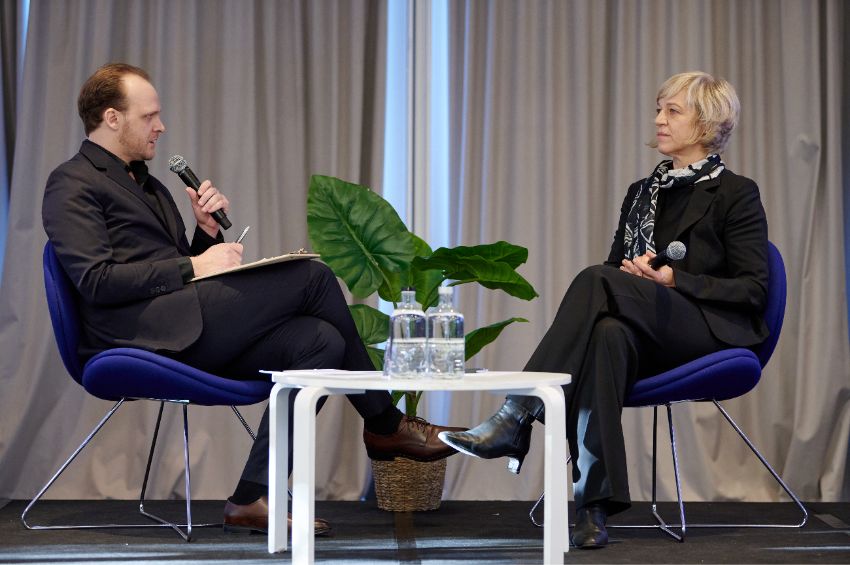 Carl-Johan Karlsson and Renate Nikolay
The first discussion debated whether Europe risks dependency on dominant global platforms, and what realistic alternatives look like. Brice Allibert, Policy Officer at the European Commission’s Directorate-General for Competition (DG COMP), pushed back on simplistic framing, arguing the “deeper challenge is market power and lock-in dynamics”. MEP Stéphanie Yon-Courtin (Renew, France) warned that Europe is at a “strategic crossroads” and must act decisively if it wants to avoid being trapped into long-term reliance on systems it does not control. MEP Aura Salla (EPP, Finland), rapporteur on the Digital Omnibus Package, stressed the vulnerability of essential services if access to key providers were disrupted and argued that “public procurement can be a practical lever to create demand for European and open-source options”, rather than waiting for market shifts to happen by themselves.
Discussion quickly turned heat, as Yon-Courtin pointed to enforcement and credible implementation as the difference between strong law and strong results, while Salla argued that Europe needs faster pathways to interoperability and easier switching to make competition real for users and public bodies. Dan Nechita, EU Director at the Transatlantic Policy Network returned to the role of competition by concluding that regulation did not cause Europe to be where it is, as “maybe our model is to produce smaller scale companies with many players, not multinationals like Google”.
 From left to right - Peder Schaefer, Brice Allibert, MEPs Stéphanie Yon-Courtin and Aura Salla, Dan Nechita, and Patrick Grady
The audience echoed a similar tension and challenged whether a hard break with major platforms is either realistic or desirable, and pointed to the complexity of enforcement and compliance work already under way. Speakers broadly converged on a more gradual reading of sovereignty: creating credible alternatives, lowering barriers to switch, and using public demand to help alternatives grow.
Public procurement can be a practical lever to create demand for European and open-source options - MEP Aura Salla
The next conversation shifted to connectivity, focusing on whether Europe’s networks can support an economy that increasingly runs on cloud services, data-intensive applications and artificial intelligence. MEP Matthias Ecke (S&D, Germany) framed the challenge as structural: “uneven rollout, performance gaps and new security risks”, with the Commission’s forthcoming policy agenda seen by many as a chance to reduce fragmentation while maintaining competition. Kamila Kloc, Head of Unit at the European Commission’s DG CNECT, Content and Technology, stressed that closing remaining coverage gaps is expensive, and that “policy needs to address both supply and demand while reinforcing resilience in the face of new threats”.
From industry, Marc Vancoppenolle, Vice President at Nokia, made the case that connectivity is not a background issue but a prerequisite for Europe’s industrial and security goals, warning that “lagging on advanced network capabilities risks slowing deployment of new applications”. Zach Meyers, Assistant Director at the Centre of Regulation in Europe, offered a cautionary note, arguing that “Europe’s telecom markets have delivered affordability” and that reform should be focusing on targeted investment and take-up where it produces measurable gains.
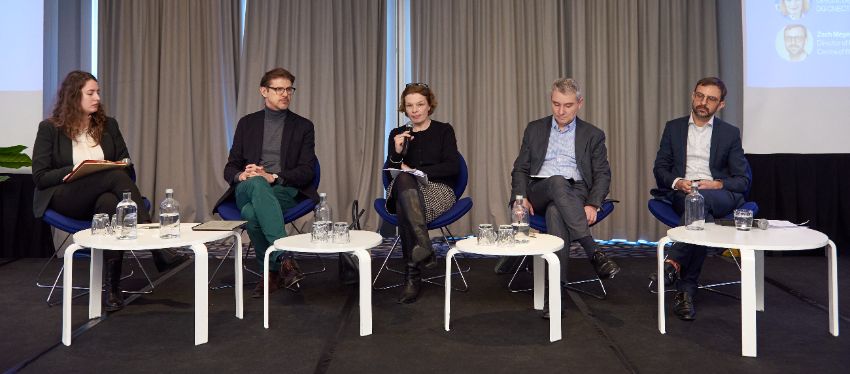 From left to right - Júlia Tar, MEP Matthias Ecke, Kamila Kloc, Marc Vancoppenolle, and Zach Meyers
Audience interventions focused on what simplification would mean on the ground, pressing for clarity on cross-border operations and whether proposed reforms would reduce duplication for providers working across Member States. Kloc highlighted the intent to streamline obligations and reduce friction, while acknowledging that “networks remain locally anchored” and that reforms need to work within that reality.
Artificial intelligence then took stage, with speakers testing the balance between clarity, competitiveness and workable compliance. MEP Sandro Gozi (Renew, France) argued simplification only works when it removes duplication and increases certainty, warning against “simplifying in ways that dilute accountability or respond to political pressure” rather than real operational needs. MEP Arba Kokalari (EPP, Sweden) emphasised that uncertainty and uneven interpretation can already slow startups and scale-ups, and that “predictable expectations matter as much as big announcements”.
 From left to right - Peder Schaefer, MEPs Sandro Gozi and Arba Kokalari, Malgorzata Nikowska, Prof. Paul Timmers and Pranav Pathak
From the private sector, Pranav Pathak, Director of Public Policy at Booking.com, argued that, rather than regulation, the key risk is long periods of legal uncertainty, which “freeze development cycles and discourage experimentation”. Malgorzata Nikowska, Head of Unit at the European Commission’s DG CNECT, highlighted the need for practical support to help organisations “adopt artificial intelligence in day-to-day processes” rather than as a side project. KU Leuven’s Professor Paul Timmers pushed for a broader view of capability-building that pairs industrial policy with attention to democratic resilience and the workforce transition that will follow widespread adoption.
Predictable expectations matter as much as big announcements - MEP Arba Kokalari
The day closed with a focuse on payments, fintech and the logic behind a digital euro. Peter Kerstens, Adviser at the European Commission’s Directorate-General for Financial Stability, Financial Services and Capital Markets Union (DG FISMA), explained that the rise of stablecoins has made policymakers “more concerned that digital money” and could become purely private unless a public option exists alongside private innovation. MEP Diego Solier (ECR, Spain) expressed scepticism about public systems competing with private innovation, arguing “Europe should instead focus on enabling European companies to grow and remain European as they expand”. Weimert returned to the argument that “sovereignty is built through adoption and execution”, warning against fragmented approaches that multiply internal complexity instead of strengthening Europe’s ability to deliver widely used solutions.
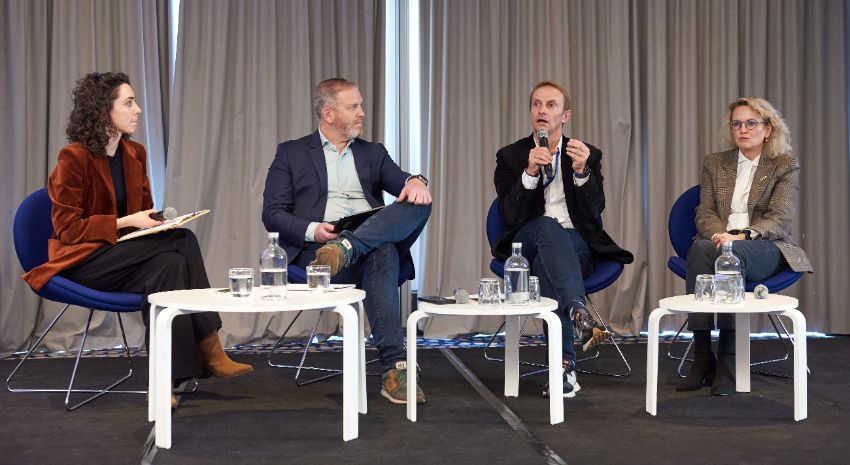 From left to right - Eleanor Butler, MEP Diego Solier, Peter Kerstens, and Martina Weimer
Across the day’s discussions, the same message resurfaced in different forms: Europe’s challenge is less about writing new ambitions and more about making its digital ecosystem easier to build in, easier to invest in, and easier to adopt. Whether the topic was platform dependence, network investment, artificial intelligence rules, or payments infrastructure, speakers repeatedly came back to reduce fragmentation, make compliance predictable, and use practical levers such as standards and procurement to turn policy into capability.
Sign up to The Parliament's weekly newsletter
Every Friday our editorial team goes behind the headlines to offer insight and analysis on the key stories driving the EU agenda. Subscribe for free here.