At The Parliament‘s Circular Economy Forum, which gathered 19 speakers and more than 180 attendees, policymakers, industry leaders, and civil society representatives were brought together to discuss how the EU can turn ambitious circular economy targets into industrial reality.
The day’s discussions reflected a wider shift in thinking about the circular economy over the last decade.
“In the past, people have seen a circular economy as a nice-to-have rather than an economic reality,” Paulina Dejmek Hack, Head of Cabinet to Environment Commissioner Jessika Roswall, told the event. “For me, it is about the environment and climate, but it is also about economic security, European resilience, and strategic autonomy. That is the new dimension.”
It was a point echoed by other speakers, including Belgian MEP Sara Matthieu (Greens, Belgium).
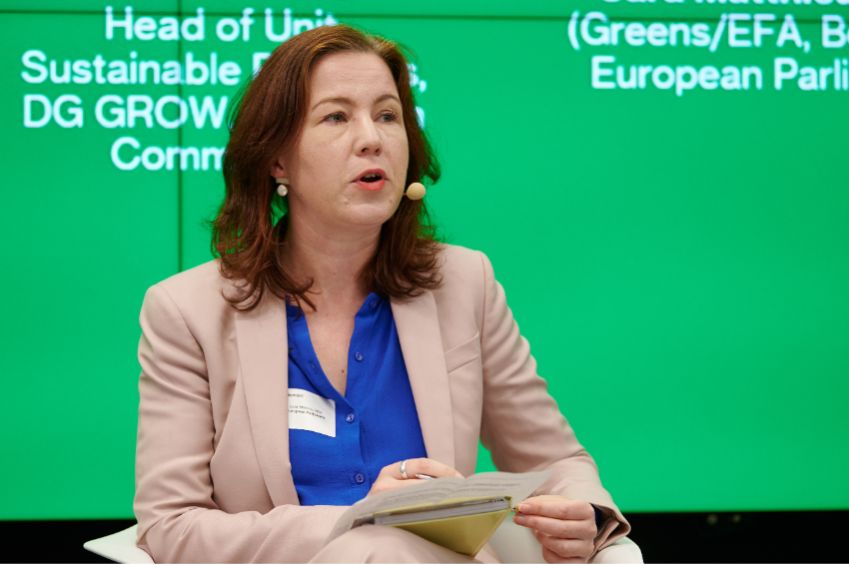 MEP Sara Matthieu (Greens, Belgium)
“It is a story on environmental impact, it is a story about depollution, and it is a story about energy usage,” Matthieu argued. “But it is also an economic story and it always has been.”
Much of the discussion understandably focused on the forthcoming Circular Economy Act, the creation of a functioning single market for secondary raw materials, and the wider challenge of combining sustainability goals with industrial competitiveness. Those issues have come into sharper focus amid a rapidly changing geopolitical environment, which has accelerated the shift in thinking around circularity. As Dejmek Hack said, “We are now living in a world where we have to use our resources in a smarter way.”
One area where such smart thinking is vital is water security. MEP Thomas Bajada (S&D, Malta) warned that Europe simply cannot build a circular economy without addressing mounting pressures on water systems. “We can never have a circular economy if we do not have water,” he said.
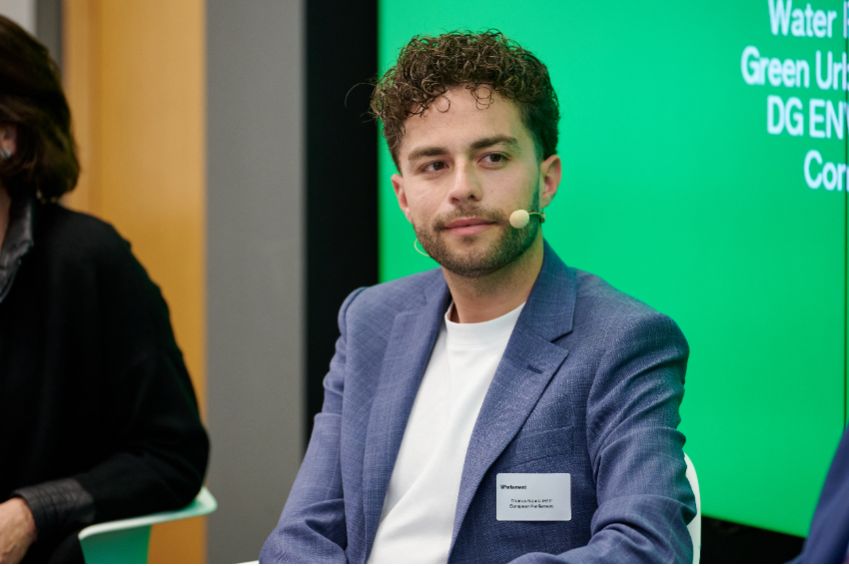 MEP Thomas Bajada (S&D, Malta)
Veronica Manfredi, Director for Zero Pollution, Water Resilience and Green Urban Transition at DG ENV, highlighted the enormous scale of coordination required to deliver the EU’s water resilience agenda. “There is an enormous fragmentation,” she pointed out. “This is recognised by everyone.” However, she added that the tensions between industrial competitiveness, resource extraction, and environmental protection also presented opportunities for innovation, calling for “mitigation by design.”
Aurel Ciobanu-Dordea, Director for Competitive Circular Economy and Clean Industrial Policy at DG ENV, agreed and cautioned that scaling circularity would require significant structural reform. “We can no longer work with the current system where we have a huge fragmentation,” he said. “The current price signals do not recognise the value of circularity sufficiently.”
We are now living in a world where we have to use our resources in a smarter way
For industry representatives, much of the focus was on ensuring that future legislation creates workable investment conditions while recognising the realities of industrial supply chains. Representatives from SUEZ, UNESDA Soft Drinks Europe, Metal Packaging Europe, and the Food and Beverage Carton Alliance (FBCA) all stressed the need for predictable rules, stronger infrastructure, and better functioning secondary materials markets.
MEP Sirpa Pietikäinen (EPP, Finland) also called for more regulatory clarity. “We need legal certainty, and for legal certainty, we need a high ambition level,” she said. “We know what to do. We need to start acting.”
Krassimira Kazashka, CEO of Metal Packaging Europe, said the Circular Economy Act presented an opportunity to create a more coherent framework. “With the Act, we have an opportunity to get it right,” she said. But she went on to warn that Europe risks undermining its own industrial ambitions if circular materials continue to leave the bloc.
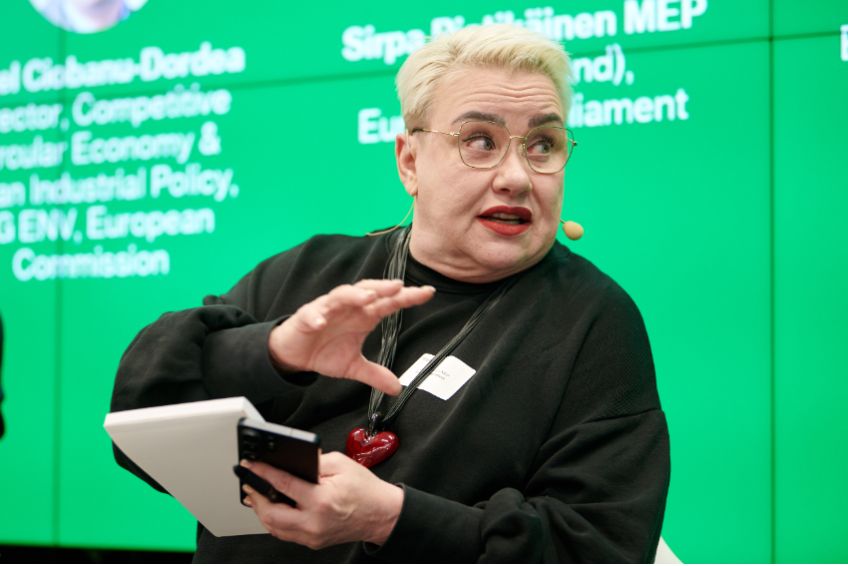 MEP Sirpa Pietikäinen (EPP, Finland)
Robert-Jan ter Morsche, Governmental Affairs Director Europe at Ardagh Group and Chair of the Advocacy Working Group at Metal Packaging Europe, said policymakers needed to focus more closely on quality throughout the recycling chain. “The more you start focusing on quality, the more you create the conditions for circularity,” he explained.
The role of legislation in accelerating change was another recurring theme throughout the day. Matjaž Malgaj, Head of Unit for Sustainable Products at DG ENV, argued that regulation remained necessary to shift industrial behaviour at pace.
Questions around implementation also dominated the discussion among packaging and consumer goods representatives. Konstantinos Malandrinos, Senior Policy Director, European Affairs at the FBCA, argued that circularity could not be achieved through product design alone. “You can design the best packaging in the world,” he said, “but you cannot get it back in the loop if you do not get it collected by the end consumer.”
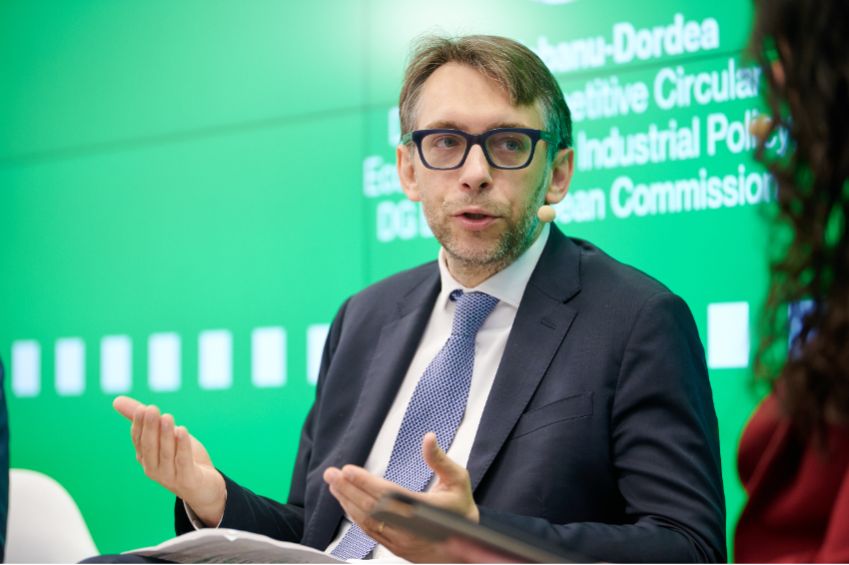 MEP Pierfrancesco Maran (S&D, Italy)
Nicholas Hodac, Director General of UNESDA Soft Drinks Europe, said industry needed clear and predictable regulation in order to invest effectively. “Industry cannot implement what it does not know,” he said. “We need legal certainty.” He added that businesses were already moving ahead of legislation in some areas. “We do not wait for legislation to happen,” he said. “We take action.”
Alongside questions of competitiveness and implementation, speakers also warned against losing sight of outcomes. Eva Bille, Head of Circular Economy at the European Environmental Bureau, cautioned that a gap remained between policy ambition and delivery. “There is still a wide gulf between what is there on paper, what could happen, and what will happen,” she warned.
The more you start focusing on quality, the more you create the conditions for circularity
Across all of the day’s discussions, there was broad agreement that Europe is now at a defining moment for the circular economy transition. There was also recognition that the next phase will depend less on announcing new policies and targets and more on building the systems and infrastructure that will deliver circularity in practice.
That is now seen as essential for much more than environmental reasons. As MEP Pierfrancesco Maran (S&D, Italy) put it, “Some years ago, we said we have to shift because we have to save the planet. Now it’s not only to save the planet, but to save our lifestyle and our economy.”
Sign up to The Parliament's weekly newsletter
Every Friday our editorial team goes behind the headlines to offer insight and analysis on the key stories driving the EU agenda. Subscribe for free here.