Wind turbines are being blamed for everything from whale deaths to blackouts — and Europe’s wind industry says the disinformation campaign is starting to reverse decades of progress.
These are among the most common false narratives spreading across social media about wind power, the renewable energy source that far-right populists and conspiracy theorists love to hate.
For decades, images of wind turbines dominating the countryside have fueled bitter resentment among local communities and far-right climate-change deniers, who argue that they damage biodiversity, encroach on land once devoted to traditional agriculture and cause cancer.
But unlike in the U.S., where President Donald Trump famously called wind farms “ugly, expensive and inefficient,” Europe had largely been spared the worst anti-wind myths. Until now.
“It's becoming increasingly complicated in Europe to build wind farms, especially onshore, based on public acceptance,” Christopher Zipf, a spokesperson at lobby group WindEurope, told The Parliament.
A social media investigation conducted by WindEurope and research group CASM Technology found that an anti-wind online ecosystem produced 42,947 posts across six social media platforms, generating approximately 6.3 million engagements and tens of millions of views between May 2024 and February 2026.
Anti-wind sentiment is rising just as the U.S.-Israel war with Iran sends energy prices soaring, strengthening the case for homegrown renewables as a matter of energy security.
“We cannot allow disinformation to delay or derail the expansion of renewable energy at the very moment we need to accelerate it to lower costs for our consumers and to strengthen our resilience,” Dan Jørgensen, the European Union’s commissioner for energy, said in a statement at the launch of the report earlier this month.
The European anti-wind network
At the heart of anti-wind disinformation lies a homogenous network of anti-wind groups, media personalities, activists and politicians, the report found.
Anti-wind groups typically present themselves as local grassroots movements, attending public meetings and on-the-ground protests. But if they are extremely active on social media, their posts generate only scant engagement. By contrast, fringe outlets are able to reach a far larger share of the population, especially when their content is picked up by mainstream center-right media.
“What we saw is that most of the content was generated by these bottom-up anti-wind movements, especially on Facebook and X. They’re spreading a large number of mis- or disinformation-related narratives while generating relatively little engagement,” said Jon Jones, a senior analyst at CASM Technology.
Instead, he explained, “the bigger media accounts and political figures might post far less frequently, but when they do, they reach much broader audiences.”
The report also points to a staggering divide between where the bulk of anti-wind content is generated and where it gets the most traction. Sweden, France, Norway, Finland, the U.K. and Germany rank highest in terms of posts published, making up approximately 74% of all content considered in the analysis.
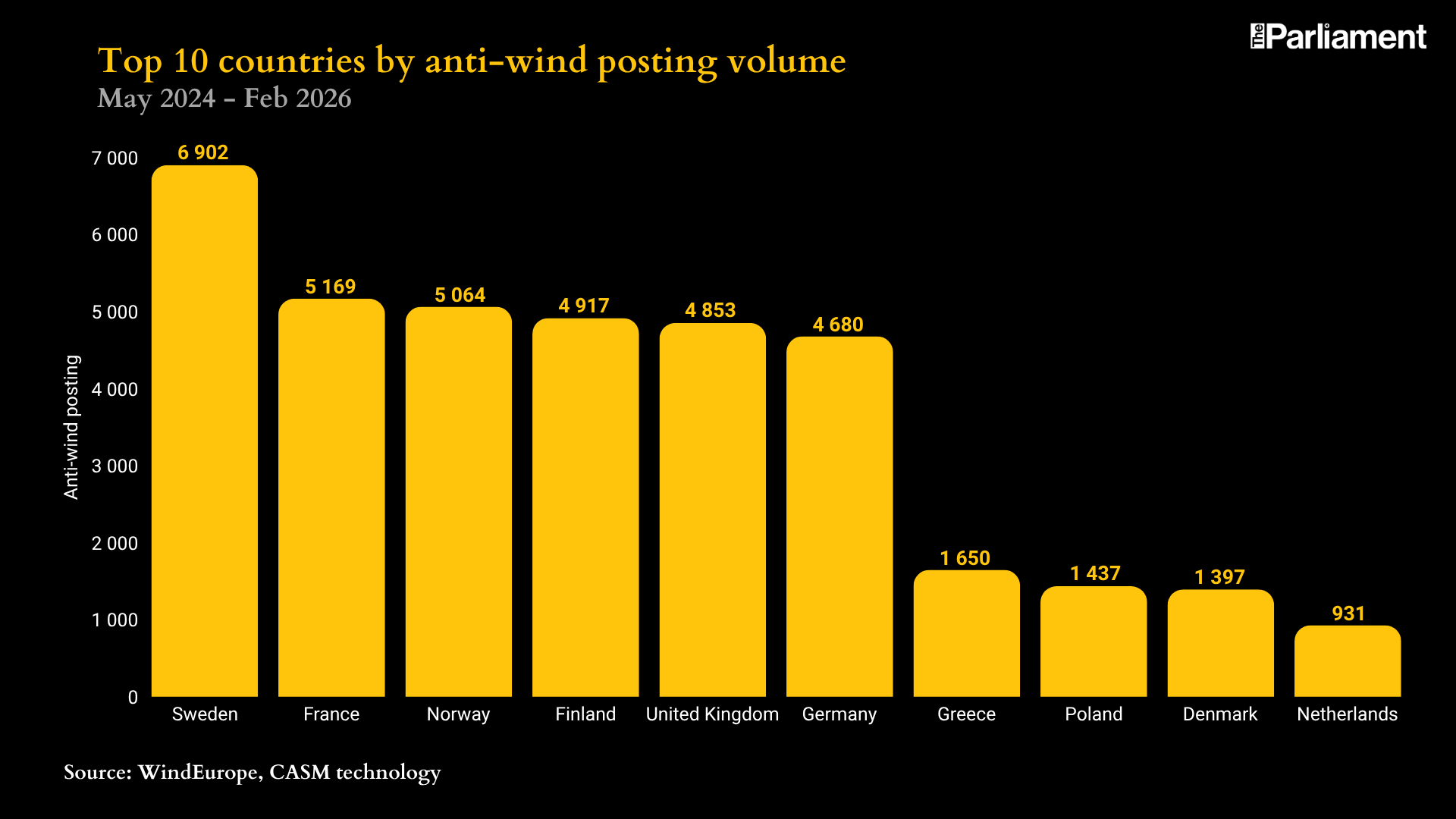
And yet, most engagement is generated elsewhere — notably in Poland, Bulgaria, Slovakia, Italy, Greece and Czechia.
The report also notes how different narratives resonate with various audiences. For instance, it found that false claims about technological viability are much more likely to gain traction in France and Poland, while citizens in Latvia, Italy and Norway appear to be more susceptible to accusations of corruption and fraud.
Online disinformation, real-life impact on wind
Narratives may spread online, but their consequences are harnessed in the real world.
“This is impacting wind farms worth billions of euros that are either getting delayed or even cancelled,” Zipf said.
The report listed several instances in which multi-billion-euro projects collapsed amid local resistance, often mobilized around debunked claims. A notable example is the Bulgarian municipality of Vetrino, which imposed a moratorium on wind power in 2022 amid false claims that wind turbines would cause cancer and trigger an environmental disaster.
While the Bulgarian case is often regarded as a textbook example of manufactured resistance to wind power, it is far from unique. In Austria, an anti-wind campaign rooted in false claims that wind turbines would destabilize the grid and spread microplastic pollution helped the far-right Freedom Party of Austria and anti-wind groups win a public referendum banning the construction of wind turbines in Carinthia, in the eastern Alps.
The report stops short of identifying who is funding the campaigns, but notes that the Kremlin is widely suspected of backing climate disinformation efforts — particularly against renewable energy — as expanding green power would reduce Europe’s dependence on imported fossil fuels.
Sign up to The Parliament's weekly newsletter
Every Friday our editorial team goes behind the headlines to offer insight and analysis on the key stories driving the EU agenda. Subscribe for free here.