At The Parliament’s International Women’s Day Talks 2026, policymakers, doctors, researchers, and industry representatives gathered to discuss stigmatised women’s health issues, including menopause and maternal mental health, and their wider continental impact.
Setting the stage for the discussion, MEP Cynthia Ní Mhurchú (Renew, Ireland) cited the pro-abortion initiative “My Voice, My Choice” as a one-of-a-kind campaign that has made strides for women’s rights across Europe. However, she emphasised that “sexism still runs rampant in society”, recounting a personal episode in which, during an intervention at the European Parliament, a fellow far-right member allegedly made pig noises at her, stating that “things have not changed much.”
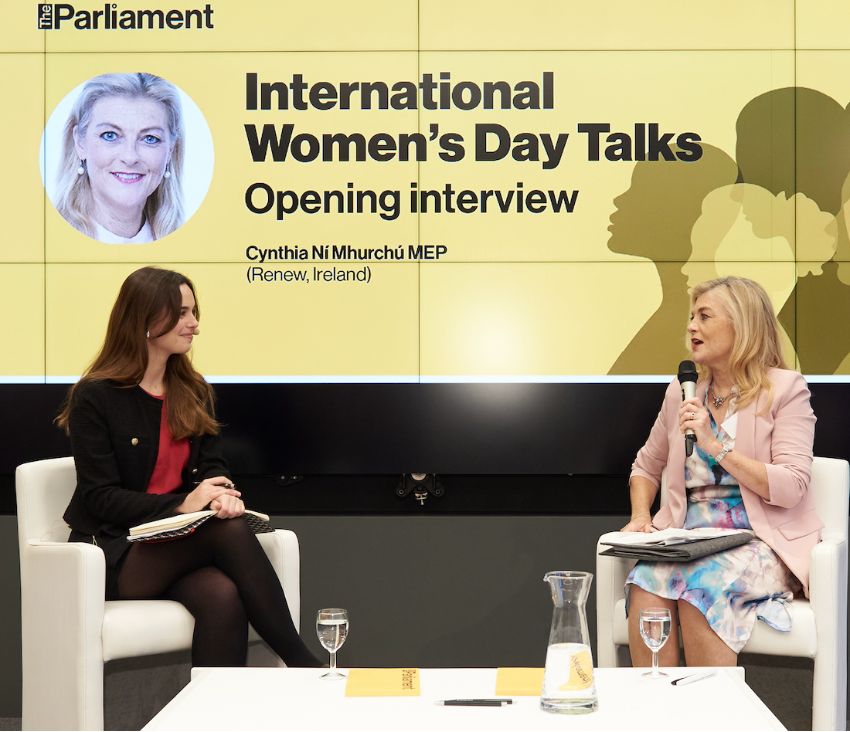 Paula Soler and MEP Cynthia Ní Mhurchú
She urged European citizens to actively petition their own governments, as many health-related issues fall under the competence of Member States, and called for greater funding for gender and women’s health policies, even amid current defense-focused challenges, highlighting the significant advancements her home country of Ireland has achieved in recent years.
Moreover, as Renew lead negotiator for the upcoming European medical device framework, she shed light on the slow process medical devices face in the bloc before being registered and integrated into the market, a process that can take approximately five years. She, therefore, advocated speeding up this process “for the sake of EU citizens’ and women’s lives”.
Sexism still runs rampant in society. Things haven’t changed much - MEP Cynthia Ní Mhurchú
Turning to another aspect of women’s health, MEPs, industry representatives, and doctors discussed one of the least systematically addressed stages of a woman’s life: menopause, which can lower bone density and lead to longer-term conditions such as osteoporosis, if left untreated.
Described by Dr. Friederike Eva Sabine Thomasius, Head of Clinical Osteology at the Frankfurt Bone Health Center, as a “silent epidemic,” she explained how its chronic undertreatment can be linked to erroneous studies, citing the misrepresentation that followed the results of the 2002 Women’s Health Initiative. She stressed the need to share correct information among patients and primary care doctors to counter this controversy which still discourages women from seeking hormonal therapy.
At the same time, Dr. Meryam Schouler-Ocak, Chair of the Board of the European Institute of Women’s Health (EIWH), noted that “untreated symptoms can lead to absences and early exits in the workplace”, affecting productivity and tax revenue. Pointing out the uneven access to large-scale treatment, she also called for menopause to be included in the EU Women’s Health Strategy, alongside increased funding for research, explaining that “We need data, because what gets measured gets managed.”
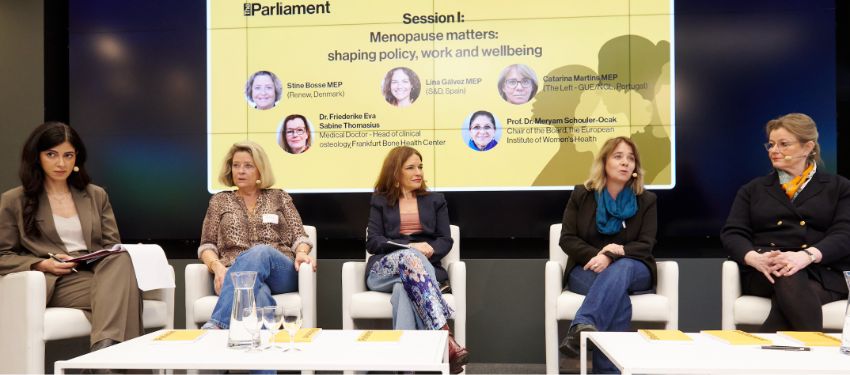 From left to right - Sarah-Taïssir Bencharif, MEP Stine Bosse, Dr. Friedrike Eva Sabine Thomasius, MEP Catarina Martins, Prof. Dr. Meryam Schouler-Ocak
MEP Lina Gálvez (S&D, Spain) supported these points, urging also more research and funding in this area and cautioning that “women’s health research is facing a backlash” in countries such as the US, Argentina, and Hungary. Similarly, MEP Catarina Martins (The Left, Portugal) also advocated for the integration of menopause into the EU Health Strategy, arguing that it has disappeared from the European Commission’s draft budget for the European Competitiveness Fund (ECF) and noting as well the growing role of male-biased AI data in healthcare.
On the same issue, MEP Stine Bosse (Renew, Denmark), Chair of the Women’s Health Group, emphasised as well the need for stronger funding for menopause policies. However, she pushed back against the claim that health is neglected in the ECF, underlining that “the fund still includes health components”.
Beyond menopause, maternal mental health was also raised as a key issue with post-partum depression affecting 12% of mothers across the EU. In this context, Johanna Schima, Vice-President & Head EU Delegation at Make Mothers Matter shed a light on its multigenerational nature, since children of affected mothers face “higher risks of behavioural, cognitive, and emotional problems” and therefore urging legislative revision to fight this condition and broader maternal mental health issues.
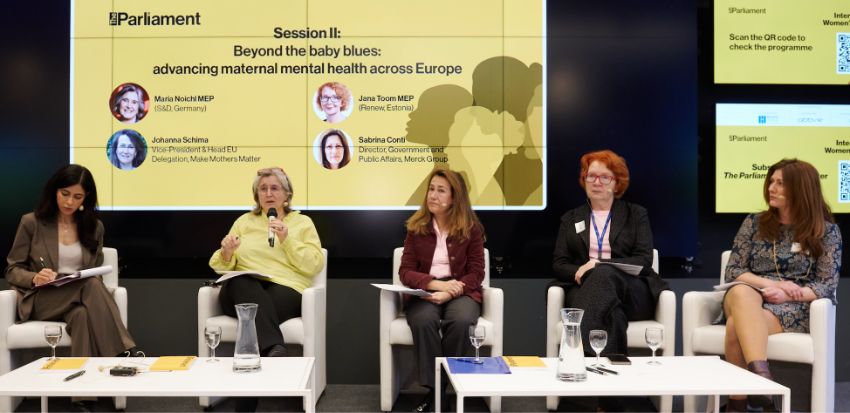 From left to right - Sarah-Taïssir Bencharif, MEP Maria Noichl, Johanna Schima, MEP Jana Toom, Sabrina Conti
Specifically, she urged the revision of the 2019 Work-Life Balance Directive, arguing that its implementation remains uneven across Member States and that “the minimum ten days of parental leave are insufficient for mothers and fathers alike”. The directive’s flexible working provisions were also criticised for guaranteeing only the right to request such arrangements.
Echoing these concerns, Sabrina Conti, Director of Government and Public Affairs at Merck Group, underscored that policy frameworks should embrace the concept of equal parents and guarantee a holistic approach to the maternal journey, including the “silent strugglers” such as women and men affected by infertility, and called for the Multiannual Financial Framework (MFF) and national budgets to better support families.
Women’s health research is facing a backlash - MEP Lina Gálvez
Arguing similarly for stronger protection of mothers in the labour market, MEP Jana Toom (Renew, Estonia) also advocated for better parental and gender equality legislation, although she expressed scepticism about the prospects for new directives “given the current majority in the European Parliament.”
Moving from maternal and midlife health, attention turned to gynecological cancers, recognised as a key health priority throughout a woman’s life. Citing the successful example of cervical cancer prevention in the EU, Linn Mandahl, Vice President Europe Region South at AbbVie, contrasted this progress with the ongoing challenges faced by women with ovarian cancer, where no clear screening is guaranteed and late diagnosis remains common. She argued that “healthcare systems across the bloc remain insufficiently prepared to deliver such treatments” and recommended for this issue to become a priority for Member States.
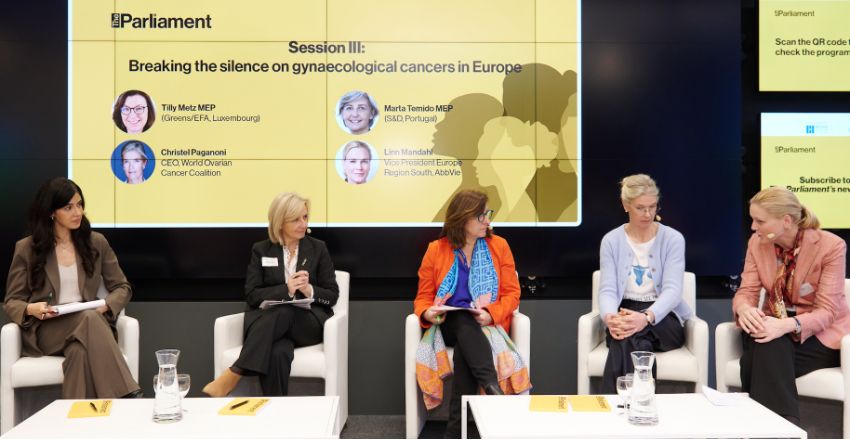 From left to right - Sarah-Taïssir Bencharif, MEPs Marta Temido and Tilly Metz, Christel Paganoni, Linn Mandahl
Christel Paganoni, CEO of the World Ovarian Cancer Coalition, reinforced this point, describing ovarian cancer as “like a silent killer, but not truly silent, because women do speak up; it is the system that is not always listening.” She called for better screening and funding, stating that “If we really want to make a difference, name it, measure it and fund it.”
Her call for stronger funding was echoed by MEP Marta Temido (S&D, Portugal), who acknowledged the achievements of the European Beating Cancer Plan but described the lack of substantial funding in the next MFF as “deeply concerning”. MEP Tilly Metz (Greens/EFA, Luxembourg) concluded by arguing that women’s health “should not be treated as a niche issue limited to sexual and reproductive rights”. Instead, she stressed that a holistic, life-course approach to women’s health should become a priority for the EU.
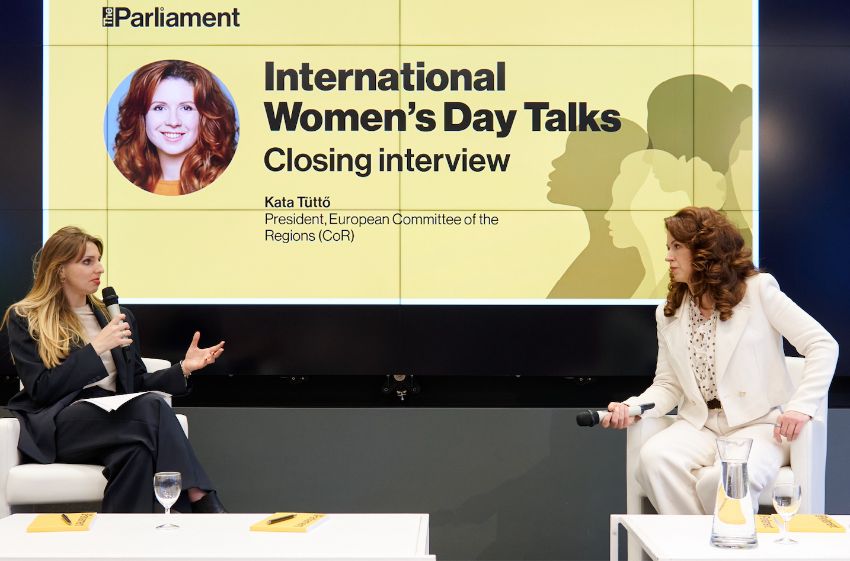 Federica Di Sario and Kata Tüttő
This year’s International Women’s Day Talks highlighted the need for a coordinated EU response to address women’s most pressing health issues. All speakers emphasised holistic approaches, increased funding, and more research as priorities across Member States. In this context, Kata Tüttő, Budapest City Councillor and President of the European Committee of the Regions, reminded that action also begins locally: in Hungary, Budapest can defend women’s rights and uphold democracy even in hostile environments, since “what you don’t practice, you lose.” Whether Member States and the EU will follow this example, or let these issues fade until the next International Women’s Day, remains uncertain.
Sign up to The Parliament's weekly newsletter
Every Friday our editorial team goes behind the headlines to offer insight and analysis on the key stories driving the EU agenda. Subscribe for free here.