Europe's security environment has changed dramatically in recent years. The war in Ukraine, growing geopolitical instability, and wider concerns around economic resilience have prompted governments across the European Union to reassess long-held assumptions.
“The security environment in Europe has changed fundamentally over the past decade,” Dennis Goege tells The Parliament. “The pandemic, followed by Russia’s invasion of Ukraine, exposed vulnerabilities in defence supply chains and highlighted that much of the Western defence industrial base was geared toward peacetime production rates.”
The systemic shocks of those global events have altered the conversation around defence. For many years, the focus was largely on acquiring new capabilities. Today, governments are increasingly focused on ensuring those capabilities can be sustained, supported, and expanded when required.
“As European governments increase defence spending and focus on readiness, resilience has become just as important as acquiring new capabilities,” Goege tells us. “A resilient defence industrial base in 2026 is defined by its ability to absorb shocks, scale rapidly, and sustain capability over time.”
That emphasis on resilience extends far beyond military equipment. It includes industrial capacity, supply chains, workforce skills, and the ability to respond rapidly to changing circumstances.
The security environment in Europe has changed fundamentally over the past decade
“It is not just about output, but about depth and flexibility,” Goege says. “It is about secure supply chains, distributed production across allied nations, and the capacity to maintain and upgrade complex systems throughout their lifecycle.”
Those priorities have become increasingly important as Europe seeks to strengthen its own defence capabilities. In Brussels and across national capitals, discussions around defence readiness are increasingly linked to questions of industrial policy, competitiveness, and strategic sovereignty.
However, Goege believes that greater European sovereignty and stronger transatlantic cooperation should not be seen as competing objectives. Instead, he sees the former playing an important role in supporting the latter.
“European defence ambitions are clearly moving toward greater sovereignty in capability, industrial capacity and decision-making, and that trajectory is likely to continue,” Goege explains. “At the same time, Europe’s security remains deeply intertwined with the transatlantic alliance, making coordination as important as capability growth.”
European policymakers continue to try and strike the right balance between sovereignty and cooperation. As governments invest in domestic production and seek to strengthen local industrial capacity, there is a growing focus on ensuring those investments complement rather than compete with wider allied objectives.
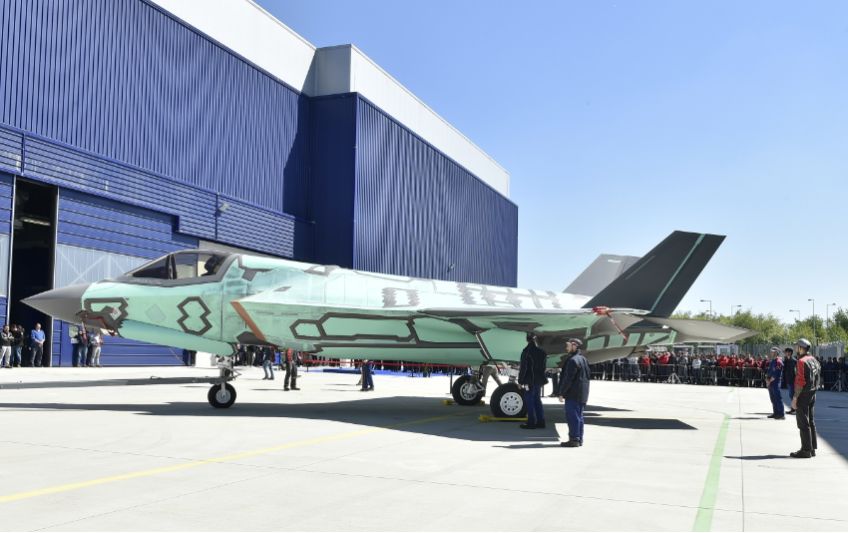 The Final Assembly and Check Out (FACO) facility in Cameri showcases the strength of Europe's F-35 industrial base, supporting aircraft production, sustainment, and long-term economic impact in Italy.
“The key challenge is ensuring that efforts to build sovereign capacity in Europe do not unintentionally lead to fragmentation or duplication,” Goege tells us. “Coordinated planning between Europe and NATO allies allows industry to expand where it adds the most value, while avoiding unnecessary redundancy.”
For Goege, the ability of allies to operate seamlessly together remains central to that vision. He believes that guiding philosophy increasingly extends beyond military systems to encompass industrial cooperation itself.
“Interoperability is also strengthened through transatlantic industrial cooperation,” he observes. “When governments and industry coordinate investments and production, they can build complementary capabilities, strengthen supply chains, and avoid unnecessary duplication.”
That approach reflects a broader recognition that defence readiness depends on networks of partners rather than isolated national capabilities. That makes the ability of governments, armed forces, and industry to work together an increasingly important component of long-term security.
There are also important economic implications too. Across Europe, defence investment is increasingly viewed not only through the lens of security, but also through its ability to support industrial growth, innovation and high-skilled employment. In practice, many of the supply chains that support defence programmes already stretch across multiple European countries, creating economic benefits far beyond individual sites.
A resilient defence industrial base in 2026 is defined by its ability to absorb shocks, scale rapidly, and sustain capability over time
In Poland, for example, PZL Mielec, Lockheed Martin’s largest production facility outside the United States, employs around 1,700 skilled workers and supports more than 6,000 jobs across its supply chain. Similarly, the F-35 Final Assembly and Check-Out facility in Cameri, Italy, has become a long-term industrial anchor for the region, supporting manufacturing, assembly, and maintenance capabilities that will remain in place for decades.
For Goege, these examples illustrate how defence investment can simultaneously strengthen security and industrial resilience.
“In practice, this is already visible in Europe through co-production and supply chain partnerships,” he says, pointing to manufacturing activity in Germany, helicopter production in Poland, and wider industrial cooperation across the continent.
Despite the scale of the challenges facing Europe, Goege remains optimistic about the future. He points to decades of successful cooperation as evidence that the foundations for future success are already in place.
“A key source of confidence is long-standing industrial cooperation between Europe and the US, which has consistently delivered both security and economic value,” he says. “It strengthens supply chains, improves interoperability between allied forces, and supports high-skilled jobs across member nations.”
The key challenge is ensuring that efforts to build sovereign capacity in Europe do not unintentionally lead to fragmentation or duplication
That cooperation has developed over decades, adapting to new threats, technologies, and geopolitical realities. Goege believes it will continue to evolve as Europe strengthens its defence capabilities in the years ahead.
For Goege, Europe's growing defence ambitions and the transatlantic alliance are not competing projects. They are mutually reinforcing. In an increasingly uncertain world, he argues, security will depend not only on stronger national capabilities but on the ability of allies to build resilience, coordinate effectively, and act together when it matters most.
In partnership with

Sign up to The Parliament's weekly newsletter
Every Friday our editorial team goes behind the headlines to offer insight and analysis on the key stories driving the EU agenda. Subscribe for free here.