Give Europeans one euro and, chances are, it will eventually be worth just 90 cents.
Europeans are proud savers, but reluctant risk-takers. Recent estimates show that they sit on more than €33 trillion in savings — the result of a "cash-under-the-mattress" mentality that the European Union is now determined to change as it looks to deeper capital markets to boost growth.
Only 20-25% of European households invest in equities, well below the 35-40% in the U.S., according to consultancy EY.
One country, however, bucks the trend: Sweden. More than 2 million people — about one-fifth of the population — directly own shares in listed companies, making the Nordic country Europe’s standout for retail investment.
“Sweden is obviously the most Anglo-Saxon of the EU members,” said Jacob Kirkegaard, senior fellow at Bruegel, an economic think tank.
Sweden’s economic parable is now turning heads in Brussels, where policymakers are looking for ways to revive Europe’s economic firepower and shore up pension systems threatened by an aging population.
“Investments can strengthen both personal finances and the overall economy in the EU,” said Morten Bødskov, Denmark’s industry minister, as he signed off a review of the bloc’s Retail Investment strategy last December.
Brussels now wants to coax Europeans out of their savings accounts and into the markets. The idea is to make investing cheaper, simpler and easier to understand, while asking capitals to help improve financial literacy. The aim is, in the EU's own words, to help Europeans “get more out of their investments.”
There’s just one problem. Many of the policies that turned Sweden into a country of investors, from pension reform to financial education, are not actually in Brussels’ hands. They belong to national governments.
How Swedes began investing
The love story between Swedes and stocks began in the 1980s, when the then center-left Social Democratic Party introduced Allemansfonder, an actively managed equity fund that offered investors tax-free returns.
Although these tax incentives were later scrapped, the fund “became immensely popular, especially because we had such high income taxes,” said Anders Anderson, associate professor at the Stockholm School of Economics.
It wasn’t until a decade later, however, that another major policy shift transformed the way Swedes looked at investing: the 1994 pension reform. Under the new system, introduced in part to ease the burden on the national budget, workers were now required to invest part of their salary — about 2.5% — in a funded "premium pension" account.
The reform laid the foundations for Sweden's equity culture, said Bruegel’s Kirkegaard. “It’s basically forced savings. You have to save, you have to allocate it, and you have a degree of freedom in it,” he said, referring to the fact that Swedes could either pick their own funds, or expect that money to be automatically allocated to a default fund.
Another turning point came in 2012 with the so-called Investment Savings Accounts, or ISK. The reform dramatically simplified the taxation of investment gains, replacing taxes on individual transactions with a low annual levy based on the account’s value. Investing no longer required a sophisticated understanding of financial markets and their hidden costs.
Meanwhile, as owning securities became commonplace, financial education became a mandatory subject in Swedish schools in 2011.
Arturo Arques, a private economist at Swedbank, said that years of getting familiar with the financial markets have ultimately taught Swedes one key lesson: “If you are persistent, regardless of whether the market goes up or down, you’ll see [your] money grow.”
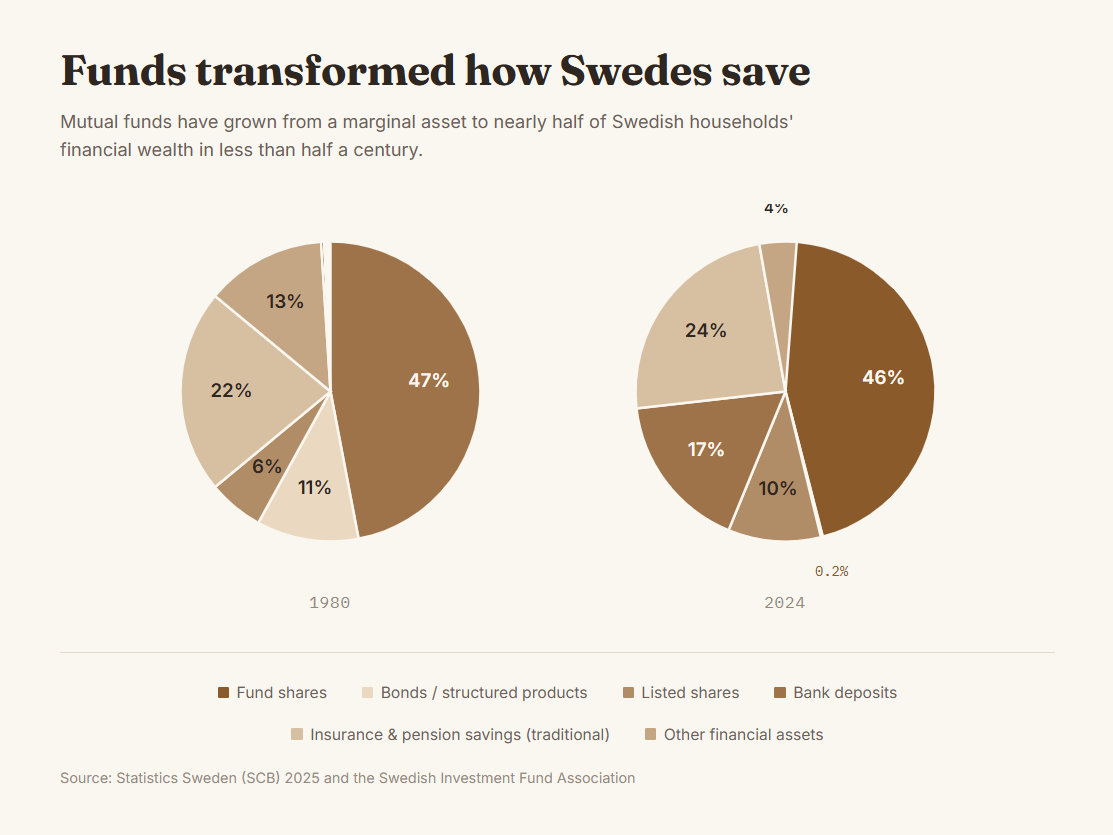
Still, there can be too much of a good thing. Swedes’ appetite for equity has drastically shrunk the share of household wealth held in bank accounts from 47% in the 1980s to 17% in 2024, leaving the population more exposed to market shocks. Arques also pointed to an alarming tendency, especially among young men, to buy stocks before they have built a financial safety net.
“They think they are Warren Buffett, but they aren’t,” he said.
The case for trusting the market
With the Swedish case study in mind, Brussels is now on a mission to turn Europeans into confident investors. Last December, the Commission, the European Parliament and the Council agreed on a set of measures designed to encourage households across the bloc to channel more of their savings into high-return stocks and bonds. The policies are intended to improve transparency, expand financial literacy and make investment products more accessible.
The logic is simple: Markets are more volatile, but over the long term, returns from stocks and bonds have historically exceeded those of financial vehicles largely perceived as safer, such as savings accounts.
The Commission points out that, had a household invested in the bloc’s stock market between 2009 and 2024, the value of its investment would have grown by more than 50%. By contrast, leaving the same amount in a bank account deposit over the same period would have left the household 10% poorer.
A rule of thumb often cited by economists is that a diversified investment portfolio tends to generate returns of around 8% a year over the long term.
Annamaria Lusardi, senior fellow at the Stanford Institute for Economic Policy Research, and director of the Initiative for Financial Decision-Making, believes that the main reason for scarce participation in financial markets is that “people don’t understand how markets work.”
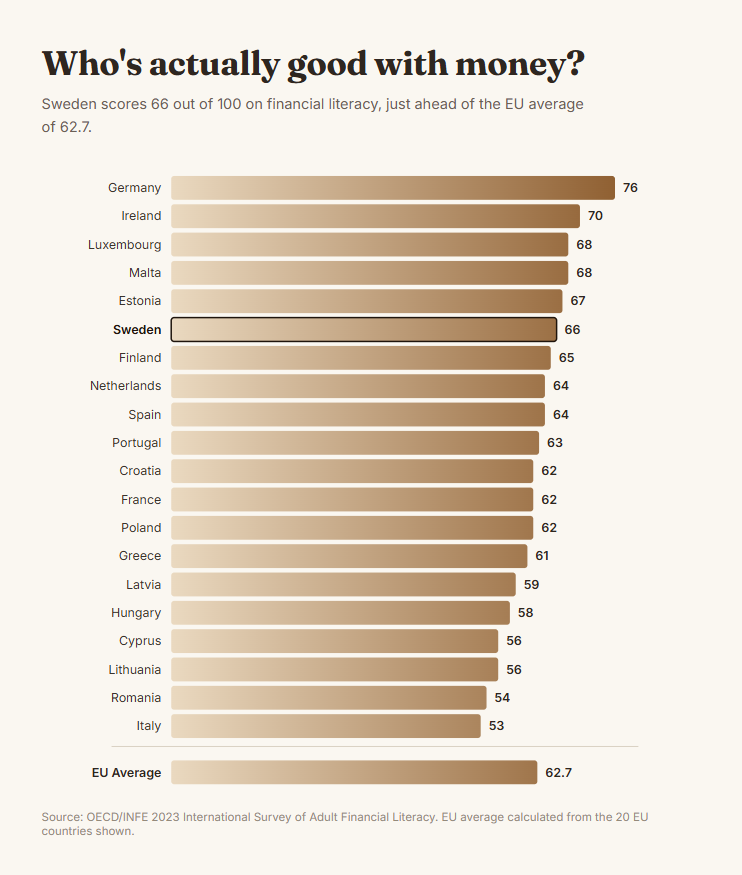
According to a 2023 survey, only 18% of European citizens have a high level of financial literacy. And even when people grasp the basics, trickier concepts can remain elusive. While 87% of respondents across OECD countries said they understood inflation, only 31% correctly defined the difference between simple and compound interest, according to an OECD survey.
Lusardi, a former member of Italy’s national committee on financial education, argued that while families may once have been able to navigate life without reaping the benefits of compound interest, a weaker economy means that’s no longer the case.
“At a time when inflation is growing, when we have to take care of our pensions, when we need to make decisions that are becoming more and more complex, participation in the financial markets is necessary,” she said.
Can the Swedish model travel?
That begs the question: Can Sweden’s equity culture be successfully replicated elsewhere in Europe, or does it rest on a rare combination of factors that policymaking alone cannot recreate?
Some analysts are bullish that other EU countries can follow in Stockholm’s footsteps and create similar opportunities for their citizens.
“All European countries would benefit from having the type of pre-funded pension systems that you really only have in three EU countries — Denmark, Sweden, and the Netherlands,” said Kirkegaard. He added there was “nothing” to prevent other capitals from “pursuing this type of gradual reform.”
And followers are already emerging.
At the end of last year, Berlin launched the Germany Fund, an instrument intended to mobilize private capital for strategic investments. Meanwhile, in a bid to foster an equity culture similar to Sweden's and encourage long-term investing, Poland last year proposed an investment savings account modeled on the ISK. Ireland, too, has recently announced it’s considering a similar savings scheme.
The EU has also created its own pan-European instrument — the Savings and Investments Union — although some experts remain skeptical about how effectively it can overcome national incentives.
“A national government is not necessarily setting up support schemes or preferential tax arrangements for investors to invest elsewhere, even in other European countries,” Kirkegaard said.
Ultimately, however, whether Europeans take greater ownership of their own long-term wealth may hinge less on the financial instruments available than on understanding how to use them.
“Having financial tools creates an extra incentive, but we can’t create an experiment so that people increase their financial knowledge,” said Lusardi.
Sign up to The Parliament's weekly newsletter
Every Friday our editorial team goes behind the headlines to offer insight and analysis on the key stories driving the EU agenda. Subscribe for free here.