Whether it’s a plate of Bacalhau à Brás in Lisbon or frozen fish fingers in Berlin, whitefish is a staple on dinner tables across Europe. The catch? Much of it comes from Russian vessels operating in the freezing waters of the Arctic, before passing through processing hubs in the European Union and eventually ending up on supermarket shelves across the bloc.
More than four years into Russia’s full-scale invasion of Ukraine, commercial fisheries remain one of the country’s last major export industries to escape direct EU sanctions. Earlier this year, the European Commission proposed changing that, putting restrictions on Russian seafood — including a full-on ban on cod — as part of a new sanctions package. But after negotiations with member states, the proposal was dropped.
The reversal was hardly surprising. Russia supplies much of Europe’s whitefish at a price and scale that are difficult to replace, while restrictions risk disrupting European supply chains for relatively limited economic damage to Russia.
But the seafood industry’s relief at the decision also highlights a by now familiar fault line in EU sanctions policy – between national economic interests and solidarity with Ukraine.
Fish escapes sanctions
The main importers of Russian fish in Europe are Germany, Netherlands, France, Poland and Portugal. Germany stands apart, importing roughly as much as the other four countries combined last year.
The country’s fish processing industry relies on frozen whitefish blocks used to produce fillet and fish fingers sold all around Europe. Around 60% of the EU’s fish finger production is based in Germany.
During negotiations over the sanctions package, Berlin argued that the economic cost at home should be weighed against the pressure import restrictions would exert on Russia. Import restrictions could threaten jobs in fish processing and across the wider supply chain, with particularly severe consequences for structurally weaker regions, a spokesperson for the German Ministry of Agriculture, Food and Regional Identity told The Parliament in an email.
Media reports indicated France, Portugal and Poland also opposed an import ban.
The European Union has introduced a few measures in the past. In 2024, it excluded Russian-caught fish from the preferential trade regime, ending duty-free access. Brussels has also blacklisted two of Russia’s largest whitefish suppliers, Norebo JSC and Murman Sea Food, for maritime espionage and sabotage, cutting them off from EU ports, finance and insurance.
Beyond those measures, however, the sector remains untouched.
"Allowing Russian caught seafood to continue to reach dinner plates in the EU does not align with bloc’s strong support for Ukraine," said Vanya Vulperhorst, head of campaigns at the European branch of environmental advocacy organization Oceana.
While fishing is far less important to Russia’s economy than energy exports, the industry still contributes to Moscow’s war machine. As in many sectors of the Russian economy, major fishing companies often maintain close ties with political authorities, especially at the regional level.
There are serious environmental concerns too. The EU has repeatedly called out Russia for illegal fishing practices. Even though Russia applies catch limits and vessel monitoring, its fisheries fall well short of EU sustainability standards.
Europe’s pollock problem
Last year the EU imported €739.8 million worth of Russian-caught seafood, with Germany, the Netherlands, France, Poland and Portugal buying 90% of the total, according to European Commission data.
Cod and Alaska pollock represented most of that trade, together worth €631.5 million.
Cod is more expensive and is central to Portugal’s salted cod industry, while cod fillets are widely sold through supermarkets and the food service sector. Alaska pollock, by contrast, is cheaper and mostly used in processed products, such as breaded fillets, fish fingers and ready-to-cook meals.
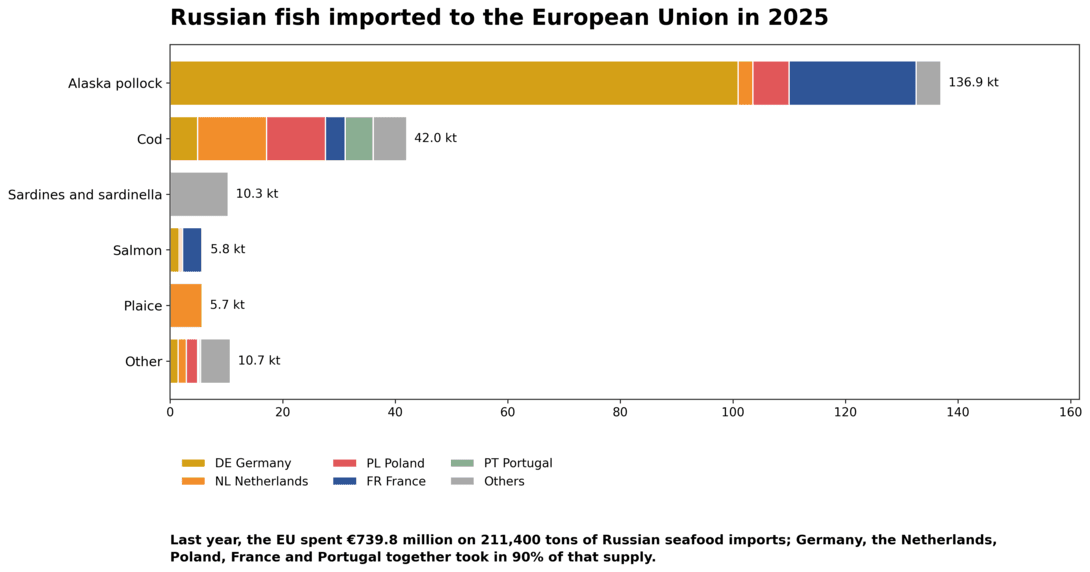
Pollock also poses the biggest obstacle to sanctions.
''Alaska pollock is one of the very few options for getting those frozen fish blocks for that reasonable price, so at the moment there is no alternative on the market," said Dr. Ralf Döering, senior advisor at the federal Thuenen-Institute of Sea Fisheries.
Germany imported most (70%) of Russian Alaska pollock last year.
Only the United States produces comparable volumes, but those are absorbed by domestic demand — especially since Washington banned Russian seafood imports in 2022 — and exports typically command higher prices.
For those reasons, the European processors welcomed the decision not to proceed with import bans. "This decision helps safeguard EU processing capacity, employment, SMEs, consumer prices and the availability of affordable seafood in the Union," Guus Pastoor, president of the European fish processors and traders association Seafood Europe, told The Parliament in an email.
More harm than good
On Russia’s end, the fish industry, although important, isn’t a critical pillar of the economy. Nor is the EU its main customer. China alone imports more than €3 billion worth of Russian seafood in 2025, compared with the EU’s €739.8 million.
"Import ban on fisheries probably won’t make the most impact on the Russian economy or capabilities to finance the war," said Gonzalo Saiz, sanctions and threat finance researcher at The Royal United Services Institute.
Could reducing imports at least benefit European fisheries?
Only to a limited extent.
Lower imports would likely push prices higher, potentially benefitting some European producers — though at consumers’ expense. The U.S. has taken a more protectionist approach. Washington banned Russian seafood imports following Russia's full-scale invasion in 2022 and expanded the restrictions in 2023 to include seafood processed in third countries. President Donald Trump renewed the ban for another year in April, in part to protect Alaska's fishing industry.
But Europe's ability to replace Russian supply domestically is limited. Some European fish populations are too depleted to allow higher sustainable catches. Rebuilding those stocks, — including critically depleted cod — is therefore crucial to reducing Europe’s dependence on imports, said Vulperhorst.
''Short-term, importers can diversify suppliers, such as sourcing cod from Iceland and Alaska pollock from the U.S.," she said. "However, diversification must avoid transferring fishing pressure to depleted stocks or creating new external dependencies.''
For Alaska pollock, the scope for diversification is particularly limited: Russia and the U.S. account for more than 90% of global production.
For now, the EU’s dependence on Russian whitefish continues to outweigh its willingness to sanction it. t Yet sanctions aren’t only about immediate economic pain. They also create leverage for future negotiations. "Our first and only card cannot be that we're going to lift sanctions on Russian central bank assets," Saiz said. "We need these smaller pieces that we can offer to the Russian government first."
"The industry also understands that it cannot avoid it forever," Döering said. "Some form of sanctions will have to come eventually if no developments happen."
Sign up to The Parliament's weekly newsletter
Every Friday our editorial team goes behind the headlines to offer insight and analysis on the key stories driving the EU agenda. Subscribe for free here.