As cities across Europe confront climate stress, housing pressure and the need for better public space, The Ellinikon offers a large-scale test case in sustainable regeneration. Sissy Iliopoulou, CMCO at LAMDA Development, discusses ambition, delivery and the human dimension of city-making.
Transforming a former airport into a functioning city is a rare undertaking. What does working at that scale teach us about how cities need to be planned and governed differently?
It’s not every day that one gets the opportunity to create a city from the ground up, particularly one within a historic, existing metro area. As one of the largest urban regeneration projects in the world, The Ellinikon can inspire people globally while also improving the real lives of residents and of Athenians. The overall lesson for us is that every decision needs to be considered in terms of how it improves lived experiences, not just at The Ellinikon, but for everyone in Athens. Every city is unique, but developing with that kind of mindset is something other cities can learn from The Ellinikon. Ask yourself how you’re putting people first.
The master plan spans 6.2 million square meters on the site of the former Athens airport, so we understand that working at such a large scale, urban redevelopment cannot simply be about the buildings themselves. We’ve been careful to take a holistic, people-first approach to The Ellinikon from day one, ensuring that all the elements that define a resilient, 15-minute city are fully interconnected and are more than the sum of their parts. We want to improve everyday life, whether that’s mobility and accessibility, climate resilience, public space, economic activity, and social inclusion, among many other crucial factors. Also important is that we ensure this project is essentially Greek and something truly unique.
The Ellinikon is not only changing physical space, but it’s changing perceptions and aspirations for what Athens can become
Since The Ellinikon sits within the wider Athens metropolitan area, we’ve also been intentional about reshaping the Athenian experience both locally and internationally. The project’s scale has the potential to reposition the city as a more modern, sustainable, and globally competitive European capital, building on what already makes Athens such a compelling destination while enhancing the overall experience of living there through greater green space and improved accessibility. Basically, the scale means we have a responsibility to Greece and Athens to make this transformative. The Ellinikon is not only changing physical space, but it’s changing perceptions, expectations, and aspirations for the future of Athens and what the city can become in the coming decades.
A great example is green space. Athens has historically had one of the lowest ratios of green space per capita of any European capital. However, nearly 70% of The Ellinikon site is dedicated to green and open public areas, anchored by The Ellinikon Park. With the new addition, the green area available to Athenians will roughly double, providing access to 2 million square meters coastal park and a one-kilometer public beach with unrestricted access. That alone has the potential to significantly transform the environmental footprint and microclimate experience of the entire city.
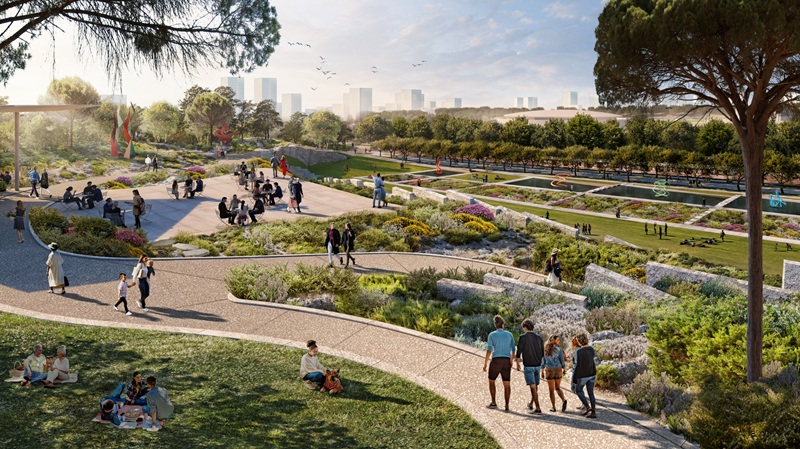 Nearly 70% of The Ellinikon site is dedicated to green and open public areas, anchored by The Ellinikon Park
Of utmost importance, we’re ensuring the city is genuinely diversified in both its uses and economy by creating a truly mixed-use environment, not just residential and commercial. Yes, we have a full range of homes, office and retail spaces, but the development also offers schools, higher education, healthcare, dining, recreation, sports, conference facilities, and hospitality, everything you would expect from a city that has evolved over generations. We’re also helping to ensure the Greek knowledge economy can provide opportunity long into the future by providing space and partnerships for research and innovation. All of this is what we mean by a people-first city.
As climate risks intensify, what does it actually take to embed resilience into a city from the outset rather than retrofitting it later?
The Ellinikon also presents an opportunity to do things the right way from the start with regard to sustainability. Most neighborhoods and cities have to retrofit or improve older infrastructure by virtue of their age. For us, resilience is designed into the structure of the city, not just by public and investor mandate. We’re doing it because it is necessary to create a truly great space that will serve the needs of residents and the community for, hopefully, centuries because it can grow as needs evolve.
This goes back to detailed planning and engineering. For example, The Ellinikon has an underground network for rainwater collection, treatment and flood protection from the ground up. We’ve dedicated the majority of the site to green and permeable surfaces that reduce urban heat and absorb stormwater. A new wastewater treatment plant will produce reclaimed water that meets the park's irrigation needs.
Another example is the construction itself. More than 95% of excavation and demolition materials are being reused on site, and at least 75% of construction waste is being diverted from landfill, practices fully aligned with the EU Circular Economy Action Plan.
Lamda's near-term emissions reduction targets have been validated by the Science Based Targets Initiative as consistent with the 1.5°C pathway of the Paris Agreement, and we have gone beyond what is required by Greek and European legislation in our environmental design standards.
Moreover, The Ellinikon is being delivered as a true 15-minute city, where residents can reach daily needs on foot or by bicycle, and major buildings are designed to international green-building standards. Embedding all of this from the outset rather than retrofitting it changes both the cost and the achievable level of ambition. We were given the rare opportunity to plan an entire urban district from a blank canvas in a European capital, and we felt a responsibility to use that opportunity well.
Europe has no shortage of urban strategies, from the Green Deal to the New European Bauhaus, but where do you see the biggest gap between ambition and delivery on the ground?
The frameworks themselves are strong. The Green Deal, the Circular Economy Action Plan, and the New European Bauhaus give coherent visions for builders and urban planners. We have aligned The Ellinikon with all three of these and in several areas gone beyond what is required by Greek and European legislation. The harder question is how that direction translates into built environments at the scale and speed the climate transition requires.
To deliver on this and bridge the gap between theory and praxis, there needs to be regulatory continuity over long timeframes, because urban projects are measured in decades or longer. Importantly, those public objectives need the support of private capital to reach fruition, and that means the project itself must be economically viable. In fact, The Ellinikon is the largest privately financed investment in Greece's history, with an estimated capital program of more than €9 billion. This necessitates that there is shared accountability for outcomes between the public and private partners involved, because both have much at stake.
The Ellinikon has been able to move forward because Greece created a stable framework for the project and public and private actors have been working towards the same goals.
There is a lot of discussion around "human-centric cities" and the 15-minute city. What does that mean in practice when you are designing an entire urban district from scratch?
The Ellinikon isn’t an urban planning experiment. We expect more than 20,000 people to live in the city, 70,000 to work here, and one million tourists to visit annually. When we say this is a model city for the world, we intend it to be a place where people can truly live better, and we take that responsibility very seriously. We don’t think every city needs to be like The Ellinikon, but we do think our people-first approach is something that can inspire others to make a similar strategy work for where they live. Starting with a blank canvas, it’s our chance to rethink what everyday life in a city can feel like and how it can elevate the quality of everyone it touches.
We don’t think every city needs to be like The Ellinikon, but we do think our people-first approach is something that can inspire others
There’s a lot of practicality that goes into this. Most importantly, how it meaningfully improves the lives of Athenians and instills a greater sense of pride. When the lived experience is elevated and idealized, know we are on the right track.
Great cities create a sense of belonging. They make people want to spend time outdoors, interact, explore, and feel connected to their surroundings and to each other. That matters especially today, when many cities globally are facing real challenges around quality of life, stress, climate resilience and social fragmentation. We believe urban development should respond to those realities, not simply by building more, but by building differently. At The Ellinikon, we are trying to create an environment where the city works better for people.
To what extent should projects like the Ellinikon be seen not as isolated developments, but as models that can inform how European cities evolve over the next decade?
Every city has its own history and culture, so we are careful when we say “model city.” It’s less about replication and more about what other cities can learn from the approach. Building on the site of a former airport gave us a lot of freedom that mixed-use and master planned developments simply don’t have, allowing us to rethink how a city can function from the ground up. At the same time, cities around the world are seeing great change in how people use them, with former industrial spaces increasingly transformed into integrated environments where people can both live and work seamlessly. From that perspective in particular, we have a lot to offer in how the spaces at The Ellinikon engage people in a climate-conscious and sustainable way.
The Ellinikon shows that large-scale urban regeneration can become a catalyst not just for physical transformation, but for broader economic and societal renewal. Once complete, the project is expected to contribute around 2.5% to Greece's GDP and produce €14 billion in incremental state revenue. The IMF also cited The Ellinikon in its October 2025 Article IV report as a contributor to Greece's continued growth momentum, and the project is helping to attract and retain talent through high-quality roles in innovation, technology and design.
For many years, Greece was associated internationally with crisis and contraction, but projects like The Ellinikon are helping shift that narrative, reflecting renewed optimism, long-term thinking, extroversion, and confidence in the country’s future. That may ultimately be one of its most important contributions, not only creating a new destination for Athens, but also driving a broader shift in how the country envisions its future, and how that future is perceived globally.
Sign up to The Parliament's weekly newsletter
Every Friday our editorial team goes behind the headlines to offer insight and analysis on the key stories driving the EU agenda. Subscribe for free here.