ZEEBRUGGE, Belgium — On a chilly February morning, the blue-hulled Nikolay Urvantsev docked in the quiet harbor on Belgium’s windmill-dotted coastline. During its weeklong journey from the Russian Arctic, the tanker — as long as the Eiffel Tower and as tall as a 22-story building — had broken through meters-thick sea ice before reaching the comparably warm waters of the North Sea.
The cargo? Some 170,000 cubic meters of Russian liquefied natural gas.
Special ships like the Nikolay Urvantsev, or so-called Arc7s, are the only ones that can manage this type of trip year-round. Without them, analysts told The Parliament, Moscow’s Arctic gas business would be severely constrained, starving the country of much-needed resources as its war of aggression in Ukraine enters a fifth year.
For Europe, that dependence raises a crucial question: What happens to these ships once their cargo is outlawed?
As opposed to the joint Chinese-and-Japanese-owned Nikolay Urvantsev, 11 ships in the 15-strong fleet of Arc7s are owned or operated by European companies, and while Europe is set to implement a full ban on Russian LNG by 2027, there’s no fully-formed plan for how to restrict their use in the shipment of Russian gas. In fact, the ships and the trade they carry are so valuable that in July, Greece opposed the 21st sanctions package to shield the Greek company Dynagas that owns many of the ships.
Without EU intervention, some analysts warn, the LNG ban might simply reroute the Arc7s from Europe to Asia — undercutting Europe’s effort to drain Moscow’s war chest. Another risk is that Russian-linked companies buy or even seize the vessels.
“If we find a good solution to this problem and prohibit the selling of these vessels to shady companies, then we could more or less blow up the Russian Arctic LNG business,” said Sebastian Rötters, a campaigner with Urgewald, a German sanctions organization. “It would not get to a standstill, but close. We could create big problems for Russia.”
The ships carrying Russia's gas
Since Russia’s full-scale invasion of Ukraine in February 2022, the EU has reduced dependence on Russian fossil fuels. In May 2022, the European Council placed sanctions on crude oil, while coal imports have fallen drastically. Gas however, used for heating and electricity generation, has been harder to remove from the continent’s energy mix, with Russian LNG still making up 13% of all gas imports in 2025, according to the European Council.
In fact, business is booming. In recent years, Zeebrugge has become Europe’s main terminal for Russian gas, with imports up by 60% between 2024 and 2025, according to an analysis of Kpler data by Ana-Maria Jaller-Makarewicz, a European energy analyst at the Institute for Energy Economics and Financial Analysis. Last year, the EU spent over €7.2 billion on Russian gas.
LNG imports from Russia into the EU have since spiked further. In January 2026, 23 out of 25 cargoes from Russian gas company Novatek’s facility on the Yamal peninsula went to Europe, according to Urgewald, with six ships unloading in Zeebrugge.
The high-tech Arc7 fleet has been instrumental. In December 2017, Russian President Vladimir Putin attended the first loading of an Arc7, where he called the development of the Arctic an “enormous task.”
The Finnish company Aker Arctic developed the design for the $300-million Arc7, with shipbuilding largely completed in South Korea in the late 2010s. Each vessel can carry 170,000 cubic meters of LNG, roughly what all of Sweden consumes in a month.
But as short-term spot-buying of Russian gas will be banned later this year and long-term contracts banned in January 2027, sanctions will effectively end the weekly voyages of the Arc7 fleet. In addition, the 20th sanctions package, proposed by the Commission this month, includes a ban on the provision of maintenance and other services for Russian-linked LNG tankers by the end of 2026.
That places Moscow in a pickle. Russia struggles to build or maintain the technologically sophisticated Arc7 vessels on its own. The only ship currently under sanctions and only one owned by Russia, Christophe de Margerie, has in the past fallen into disrepair without access to Western shipyards.
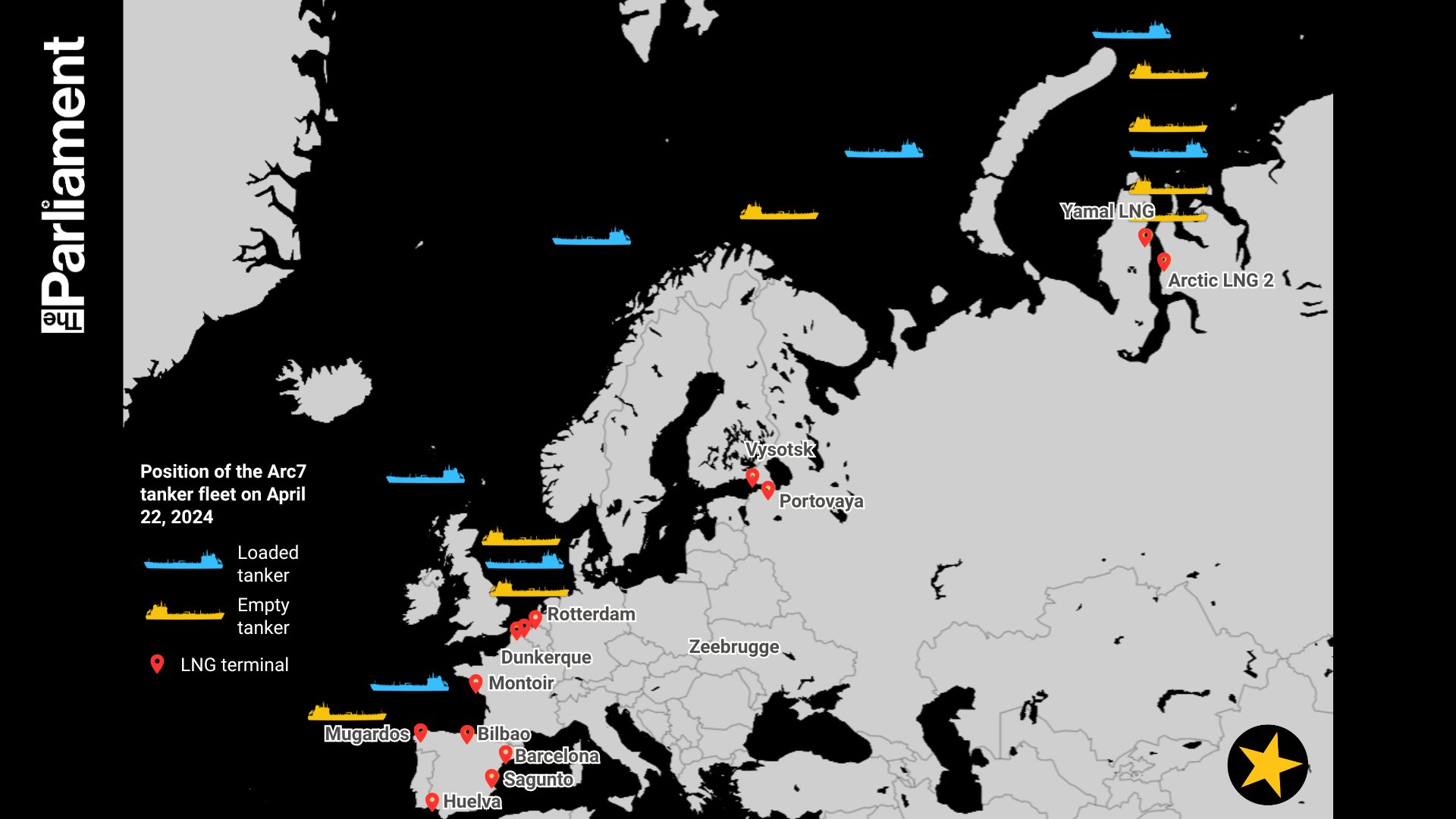 Source: Urgewald
But without EU intervention — business as usual?
Europe’s sanctions regime does place due diligence controls on ship sales to ensure that European tankers aren’t sold directly into Russian control. However, Oleh Savytskyi, a sanctions campaigner with the Ukrainian group Razom We Stand, told The Parliament that it’s up to national authorities to review those sales, and enforcement might be less stringent than on EU level. Already, former Greek vessels make up a large portion of Russia’s sanctioned shadow fleet.
The majority of the Arc7 vessels are owned or operated by two companies with significant European connections: the United Kingdom-based Seapeak Maritime Glasgow, and Greece’s Dynagas. Together, the two firms facilitated over 70% of the Yamal-Europe gas trade in 2025.
Dynagas’ chairman, shipping magnate George Prokopiou, has been outspoken against Russian sanctions, including U.K. sanctions on three Arc7 vessels in October. Dynagas didn’t respond to a request for comment on how its five Arc7 vessels would be used after import sanctions come into effect in 2027. However, in July, Greece opposed the 21st sanctions package to try and protect Dynagas and Prokopiou, according to the Financial Times.
“Dynagas and Seapeak, they are strategically tied to Novatek and to its gas,” said Savytskyi. “The whole business is because Novatek provides this gas for global markets, and this creates a business case and opportunity for European ship operators to get their money on this trade.”
Responding to sanctions campaigners in a January letter shared with The Parliament, the head of the European Commission’s sanctions unit, Michael Stelzer, wrote that “the direct or indirect provision of technical assistance, brokering services, financing, or financial assistance, as well as any other services related to the transfer of Russian LNG,” will be prohibited.
However, the Commission didn’t tell campaigners whether it would pursue blanket sanctions against all Arc7 vessels that would stop the ships from trading Russian gas elsewhere.
Another question is whether EU sanctions will prohibit maritime services providers such as Fluxys, which runs the LNG terminal in Zeebrugge, from working with Russian-linked entities. The company is bound by a 20-year contract worth €50 million per year with Yamal to provide services for LNG.
According to Fluxys’ spokesperson, Tim De Vil, current sanctions don't provide a legal basis for breaking the company’s service contract with Yamal.
France-based TotalEnergies also has an important economic relationship with Yamal — so much that the first Arc7 tanker was named by Putin after the company’s former CEO, Christophe de Margerie. Today, TotalEnergies has a 20% stake in the operation.
“The moment there are national economic interests, we enter a more difficult path because they want to protect their vessels and companies,” said Ivan Hortal Sanchez, an EU campaigner at Razom We Stand.
Sanctions questions unanswered
Even with multiple layers of sanctions and new packages underway, there are still more questions than answers about the future of the Arc7s.
Angelos Koutsis, an energy policy expert with the Flemish climate organization Bond Beter Leefmilieu, said that if there was explicit language that permitted infrastructure providers like Fluxys to break their long-term contracts with Russian companies, the 20th sanctions package would be the “final piece of the puzzle to permanently end Belgium's role as a Russian LNG hub.”
However, some doubt that even more forceful sanctions will do the job.
“If Seapeak and Dynagas are fine with their ships being used by Russian crews, I’m pretty sure they can figure out how to sell their vessels to some entity in Turkey, or the UAE,” said Malte Humpert, a senior fellow and founder at the Arctic Institute and an investigative journalist tracking Russia’s Arctic shipping fleet.
Already, Russia's security service has been successful in pushing out Western crew members and replacing them with Russians, added Humpert.
Back at the Fluxys LNG terminal in Zeebrugge, the Nikolay Urvantsev offloaded its cargo into a massive tank specifically built for Russian gas. The LNG was then regasified and fed into an underground pipeline network that spreads throughout Europe.
The next morning, the empty tanker and its Russian crew cast off from the Zeebrugge docks and began its journey up the Norwegian coastline towards Yamal, to pick up another load of LNG destined for Europe.
Sign up to The Parliament's weekly newsletter
Every Friday our editorial team goes behind the headlines to offer insight and analysis on the key stories driving the EU agenda. Subscribe for free here.