In early April, the ice-class carrier Vladimir Rusanov left Russia’s Arctic liquefied natural gas, or LNG, terminal at Sabetta carrying a cargo of LNG. After a short voyage west through the Barents Sea, it anchored off Murmansk, where its cargo was transferred to the conventional tanker Geneva. Instead of heading for Europe, Geneva sailed around the Cape of Good Hope at the southern tip of Africa, reaching Yangkou Port in China more than five weeks later.
For now, half of Russian LNG still travels the much shorter route to Europe. But Geneva’s five-week expedition foreshadows Russia’s post-2027 reality in which the European Union’s ban on Russian LNG imports will force Moscow to redirect exports to Asia.
Russian authorities have brushed off the EU ban as little more than a commercial inconvenience, insisting that LNG previously sold to Europe will simply find new buyers. But the logistical challenge is far greater than officials acknowledge. Longer voyages aren’t only more costly. They also depend on conventional LNG carriers taking over from the specialized Arctic fleet. For Russia, keeping exports at current levels will therefore require dozens more vessels, just as Western sanctions are choking off the supply.
The cost of replacing Europe
As of late 2025, nearly half of Russia’s LNG was shipped to the EU, with most originating from the Yamal LNG project operated by Novatek, Russia’s largest independent gas producer.
Those exports depend on a fleet of highly specialized Arc7 and Arc4 ice-class tankers capable of navigating Arctic waters. Deliveries from Sabetta to European terminals typically take seven to 10 days.
"There is no alternative market to Europe. It is the shortest route to earn money," said Sebastian Rötters, energy and sanctions campaigner at Germany-based environmental and human rights organization Urgewald.
Exports to Asia are a different story. Between June and late November, when Arctic ice retreats, Arc7 carriers can sail directly to Asia-Pacific via the North Sea Route (NSR), reaching Chinese ports in about three weeks.
Moscow wants to make that route navigable year-round. A growing fleet of Arc7 LNG tankers and nuclear icebreakers now allows for semi-regular winter deliveries along the eastern NSR, but those sailings remain limited, slower and more costly than summer operations. As a result, shipments to Asia rely heavily on the standard Western route via the Suez Canal — a journey of 35 to 40 days. Because ice-class tankers are scarce and expensive to run, Novatek transfers cargo to conventional LNG tankers in Murmansk before continuing to Asia.
“This means that Russia needs much more ship-to-ship capacity and conventional LNG tankers to cover the same export volumes after the EU market closes,” Rötters said.
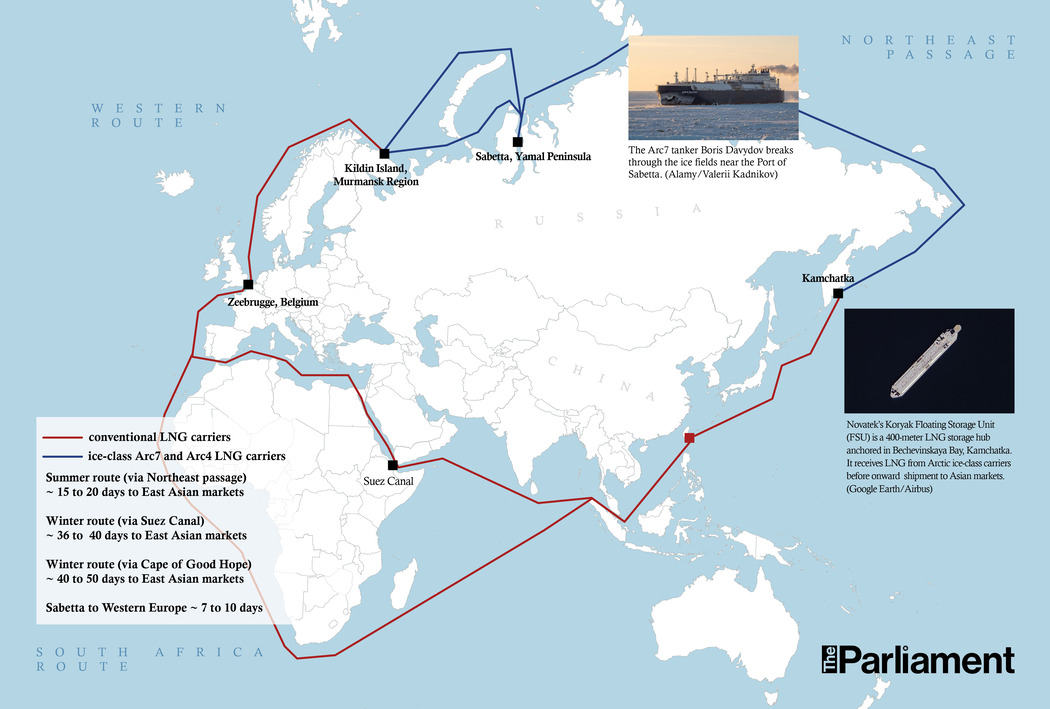 Yamal LNG supply chain to Asia. (Adobe/EvaHilinski)
The logistics became even more challenging after the Russian LNG tanker Arctic Metagaz was sunk in a drone strike in the Mediterranean Sea in March. Novatek has since rerouted shipments around the Cape of Good Hope, stretching voyages to more than 45 days while upping fuel costs by around 30%.
That single alleged Ukrainian attack has already proven costly for Russian LNG exports, said Malte Humpert, investigative journalist and founder of the Arctic Institute. "And these effects will become even more visible in 2027 when all Russian LNG will have to take the South Africa detour en route to Asia."
Indeed, after the European market closes, Yamal LNG’s current fleet — 14 Arc7, six Arc4, and five non-ice-class tankers — would be capable of only 120 to 130 voyages, compared to last year’s 270, according to the Center for High North Logistics.
Novatek would need at least another 30 conventional tankers to maintain winter exports at 2025-26 levels, said Ashley Sherman, senior LNG analyst at energy market intelligence company Vortexa.
As U.S. and EU sanctions have restricted access to newly built LNG carriers, Novatek has turned to aging vessels on secondary markets, mostly in the Middle East, using shell companies and middlemen to bypass restrictions.
The company recently bought four conventional LNG tankers for the Arctic LNG 2 project — a planned large-scale LNG plant on Russia’s Gydan Peninsula — to support summer exports to Asia. But Moscow’s efforts to expand a specialized ice-class fleet have proved more difficult, as six Arc7 tankers built in South Korea remain stranded due to U.S. sanctions.
Exemption for Greece
The EU’s LNG import ban, set to enter into force in January 2027, will also prohibit European shipowners from transporting Russian gas, regardless of destination. But when the EU negotiated the 21st round of sanctions, the measure met intense pushback from Greece.
Greek-linked ships have transported around €23 billion worth of Russian LNG since Russia launched its full-scale war in Ukraine, according to the Centre for Research on Energy and Clean Air, or CREA.
Greek shipowner Dynagas Partners manages five Arc7 and six Arc4 ice-class LNG carriers for Novatek's Yamal LNG under several long-term contracts extending past 2030. The company handles roughly a third of Yamal’s exports. Some of Dynagas' tankers travelled through the North Sea Route to China this summer. “It’s a huge Achilles heel in the Russian LNG sector,” said Isaac Levi, a Europe-Russia policy and energy analyst at CREA.
After a month-long deadlock on new sanctions, the EU conceded to Greece's request to allow its companies to ship Russian LNG to non-EU buyers in July. The Commission concluded that, due to a financial ownership structure involving Chinese entities, Greek-operated vessels will end up serving Russian LNG exports either way, just outside EU control. Hence, the ban would harm Greek’s shipping sector while having no effect on Russia's logistics, Commission officials said.
It is common for shipping companies to engage in a sale-leaseback, for instance with China Development Bank Financial Leasing, in which a bank buys vessels and immediately leases them back to the seller. This frees up liquid assets for the company, which can continue managing the vessel for years before reacquiring it for a marginally smaller price when the lease expires. Such a structure is a legitimate financing tool but one that, in Dynagas’ case, also removes the ships from EU jurisdiction. Two Chinese companies own a 51% share of the five Arc7 tankers built for Yamal LNG.
The Greek exemption highlights how shipping companies have built international networks to evade EU sanctions policies and further facilitate Russia's fossil fuel revenues.
Under the concession, Greece can continue shipping and trading Russian LNG for another year for all contracts signed prior to 2022. After that, the EU will revisit the exemption. Greece's argument for economic damage is compelling because the market for ice-class tankers is exceptionally limited. But sanctions campaigners stress that the risks of this becoming a systematic practice is high.
Nevertheless, the EU’s decision to cut off ships transporting Russian gas from maritime-related services, including insurance and maintenance, starting in 2027 still stands and it will further constrain Russia's ability to profit from the LNG exports, according to Commission officials. The new sanctions also include restrictions on LNG tanker sales, with mandatory EU oversight and “no Russia” clauses in sales agreements.
Alternative pressure points can also be explored, such as introducing a price cap or a surcharge on Russian LNG, Levy said. “That would cut into their profits used to fund war and signal that European companies aren't just serving Greek shipping billionaires and Moscow’s interests. We have this leverage; the EU shouldn't waste it."
This story was updated on July 29.
Sign up to The Parliament's weekly newsletter
Every Friday our editorial team goes behind the headlines to offer insight and analysis on the key stories driving the EU agenda. Subscribe for free here.