As temperatures begin to cool, Europeans can finally breathe a sigh of relief. But the continent won't soon forget just how disruptive a heat wave can be.
In late June, temperatures climbed above 40 degrees Celsius in Spain, France, and Italy, offering Europe a glimpse of what a partial collapse of its infrastructure and natural ecosystems could look like. Rail services were disrupted, power supplies strained and wildfires tore through swathes of land, claiming dozens of lives.
Searing temperatures are no longer unexpected in European summers. They have become one of the clearest symptoms of a changing climate, with Europe warming faster than any other continent.
While the world is now estimated to be around 1.4°C warmer than in pre-industrial times, Europe has warmed by 2.4°C. Scientists have long warned that every fraction of a degree matters, with even seemingly negligible increases making heatwaves more frequent and intense.
According to the latest figures, extreme heat in France, Belgium and the Netherlands alone caused at least 3,700 excess deaths in June. And even if it doesn't prove fatal, extreme heat disrupts sleep, saps productivity and forces outdoor workers to choose between protecting their health and earning a living.
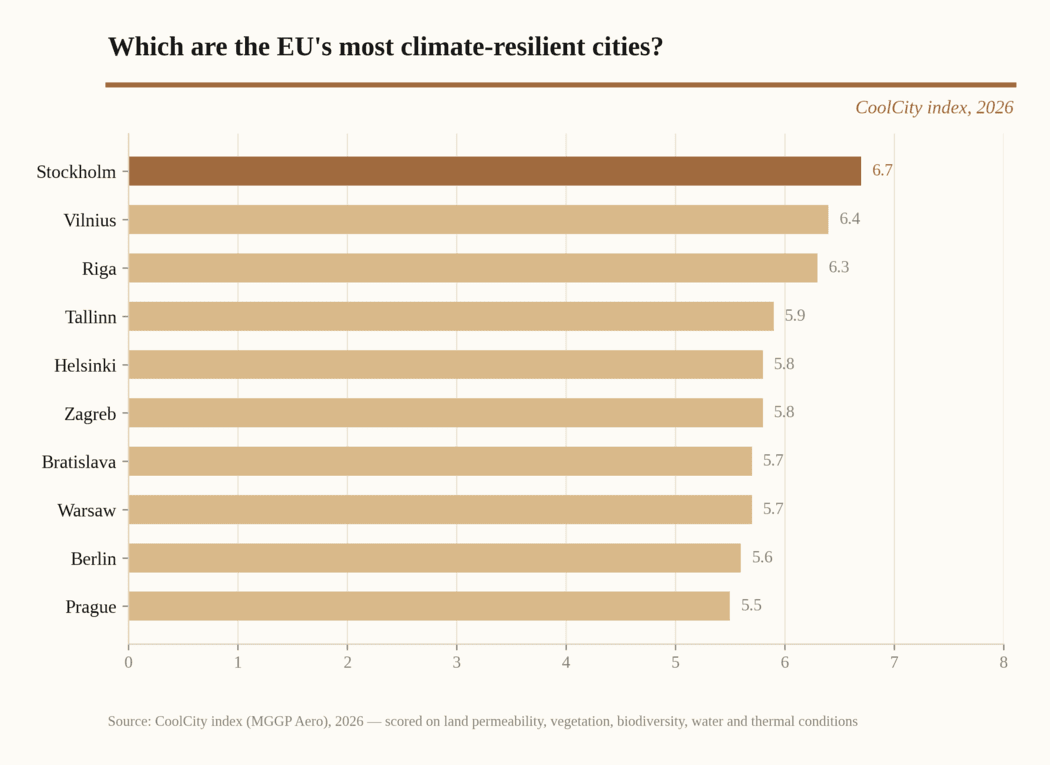
So, how is Europe preparing for a hotter future?
Cities are (slowly) adapting
As temperatures climbed, every part of urban life came under pressure.
In France, three nuclear reactors were forced to shut down as rivers became too warm to cool them. Hospitals, meanwhile, struggled to cope as a week of extreme weather drove a surge in heat-related cases. Schools shut down, and tourists cancelled their outdoor activities.
Still, researchers say European cities have come a long way since 2003, when the continent's deadliest heatwave killed around 70,000 people. The disaster served as a wake-up call, prompting policymakers to develop early warning systems and emergency protocols.
“Europe has initiated substantial adaptation efforts to heatwaves over recent years,” said Dim Coumou, a researcher at the Vrije University Amsterdam who studies how climate change turbocharges extreme weather events. “Think of heat plans in cities, early warnings, [and] cancellation of sports events,” he said.
By now, most major cities have developed heat wave response plans, ranging from mapping out water fountains to deploying “cool islands.” Paris — one of the cities hardest hit by last month’s record-smashing temperatures — had already prepared a climate adaptation strategy centered on revegetation and plans to roll out oasis points across all arrondissements.
.png)
Madrid, which has been battling unbearable temperatures for longer than most other European cities, has expanded a network of climate shelters, many housed in air-conditioned cultural venues.
Even Amsterdam, historically spared from scorching summers, is now introducing indoor cooling spaces, said Jeroen Kluck, professor at the Climate Resilient City research group at the Amsterdam University of Applied Sciences. But he acknowledged that these measures remain insufficient as many residents don't know where these spaces are.
“We’re still learning what’s effective,” he said.
Green spaces, in particular, might seem like a no-brainer. They offer shade, lower air temperatures and help people cope with heat stress. Expanding them, however, isn’t an easy task.
As the urban population grows, there’s a huge competition for space, said Katharina Hölscher, an assistant professor studying climate-resilient cities at the University of Utrecht.
Integrating urban greening into city planning from the outset is often a hard sell, Hölscher said, as parks compete with housing, gyms and hospitals. Even more innovative solutions — think vertical gardens — are often too expensive.
Air-conditioning divides Europe
At the center of cities’ climate adaptation challenge are the buildings people live in.
As soaring temperatures made apartments across Europe increasingly uninhabitable, those who could afford it rushed to buy cooling units, leaving many international observers pondering why so few households had air conditioning in the first place.
Unlike the United States, where 90% of the buildings are artificially cooled, AC remains the exception across much of Europe.
Worse, most buildings in Northern Europe were designed to retain heat rather than to keep it out. High energy costs, hard-to-navigate building laws and environmental concerns have also slowed the uptake.
Today, the debate on whether Europe should embrace air conditioning has become so divisive that some have cast it as a new front in the culture wars.
The concern, some researchers argue, is that widespread AC could ultimately make cities even hotter.
Kluck, the Amsterdam-based professor, said that air conditioning might become unavoidable for public buildings but cautioned against a fiercer uptake, especially in densely populated cities.
“If you buy an air conditioner and you're able to cool off your house, you're creating more heat that's going into the city,” he said, noting that the result will be “more hot nights,” making cooling off even harder for those who don’t have it. “Vulnerable people are even more at risk because of all the air conditioners.”
.png)
When heat deepens inequality
Like climate change more broadly, extreme temperatures disproportionately affect the most vulnerable.
Elderly people are particularly at risk as age makes it harder for the body to regulate its temperature by sweating and maintaining blood circulation. During the 2003 heatwave, more than 80% of those who perished were over 75, according to French public health data.
And as Europe's population is graying, with the average age now at 48.2 years, the risks will only continue to grow.
Prolonged heat waves have also exposed a broader divide: between those who can work from the comfort of a chilled office and those whose livelihoods depend on being outdoors, whether in the fields, on construction sites or delivering goods through sweltering streets.
Adjusting working hours have become increasingly common in recent years, said David Meredith, a senior research officer at Teagasc, Ashtown, who studies farmers' working conditions.
“We’re seeing some of these patterns in Europe as well,” Meredith said, pointing to Southern Spain and Italy. But he added that it's not a widespread practice yet, mainly due to difficulties to renegotiate different supply arrangements with supermarkets, which can simply source produce elsewhere.
“There are ways to adapt to the challenges that we see out there, but there needs to be much greater consideration of these challenges by other people within the food value chain,” he said.
Eurostat estimates that at least 17 million people work in agriculture across the EU, although widespread informal unemployment means the actual figure is likely much higher.
The limits of heat adaptation
But even the most ambitious climate adaptation plan would still fall short of making Europe livable under ever-rising temperatures.
“There are limits to adaptation," said Sonia Seneviratne, climate scientist at ETH Zurich. “We are not going to adapt to everything. And if we want it, it’s going to be very costly.”
The European Environment Agency estimated earlier this year that making agriculture, energy and transport more resilient to climate change would require investments of between €53 billion and €137 billion annually by 2050, rising to between €59-€173 billion through the end of the century.
“If you realize that we’re already reaching the limit of what we can handle, there are conditions that we won’t be able to handle,” Seneviratne added.
Sign up to The Parliament's weekly newsletter
Every Friday our editorial team goes behind the headlines to offer insight and analysis on the key stories driving the EU agenda. Subscribe for free here.