Europe is entering a decisive decade in which defence, security, and foreign policy have become central to its strategic future. The war in Ukraine, tensions in the Middle East and the Indo-Pacific, and the rise of hybrid threats have shattered long-held assumptions about European stability. Today, we understand that peace is not inherited but built every day. This new awareness has generated a historic consensus: Europe must assume responsibility for its own defence and strategic autonomy.
Within this paradigm shift, the transformation of Europe’s defence industry is no longer a circumstantial reaction but a structural change and a major opportunity to modernise the continent’s productive model, boosting technological innovation, high-value employment, and strategic sovereignty.
Across the continent, industrial actors are contributing to this evolution, and Indra Group is one of them. Through our strategic plan “Leading the Future”, Indra Group is undergoing a profound industrial and technological transformation guided by three principles: competitiveness, investment in differentiating capabilities, and the promotion of European-scale cooperation through flagship collaborative programs, fully aligned with evolving EU priorities.
The security and defence ecosystem is being reshaped by geopolitical pressure and new technological domains, such as artificial intelligence, advanced computing, secure communications, and data processing.
To remain competitive, European defence companies are scaling up their industrial and technological capacity. Indra Group, for example, has tripled its technological footprint nationwide to increase production capacity and accelerate delivery. This effort includes a major transformation of our supply chain through “Plan 500”: today, 90% of our purchasing volume is concentrated in fewer than 550 strategic suppliers, improving speed, quality, and competitiveness, in line with the broader European push to reinforce critical defence supply chains.
In the context of the war in Ukraine, rising threats across Europe, and the vulnerability of critical infrastructures, effectively delivering advanced capabilities has become essential
This industrial strengthening aligns with the Spanish government’s new Industrial and Technological Plan for Security and Defence, the country’s largest effort in decades.IndraGrouphasbeenselected to operationalize - directly or through partnerships - over half of its 31 Special Modernisation Programmes, consolidating our coordination role within Spain’s defence industrial ecosystem and reinforcing both national sovereignty and Europe’s strategic autonomy. Spain’s modernisation effort also contributes to the EU’s wider objective of strengthening collective defence preparedness.
Competitiveness, however, is only one pillar. In the context of the war in Ukraine, rising threats across Europe, and the vulnerability of critical infrastructures, effectively delivering advanced capabilities has become essential. After years of underinvestment, this is the main challenge for the sector.
Indra Group has taken a decisive step by investing in differentiating capabilities and preparing for a rapidly changing environment, through an ambitious transformation built around four new strategic divisions. Indra Land Vehicles will deliver next-generation platforms for modern land forces, supported by our majority stake in TESS, Spain’s leading manufacturer of tactical and special-purpose vehicles. The second division, Indra Weapons & Ammunition, will strengthen Europe’s industrial resilience at a moment when manufacturing capacity has become a strategic asset.
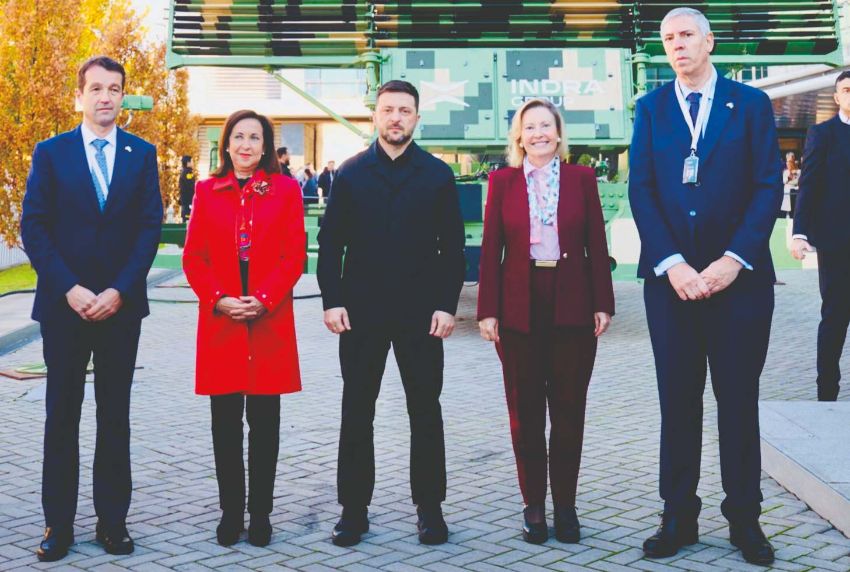 (from left to right) Ángel Escribano, Executive Chairman of Indra Group; Margarita Robles, Minister of Defence
of Spain; Volodymyr Zelensky, President of Ukraine; Amparo Valcarce, Spanish Secretary of State for Defence; and José Vicente de los Mozos, CEO of Indra Group.
Simultaneously, Indra Space is evolving into a fully integrated space actor through the incorporation of three key Spanish companies: Deimos, Hispasat, and Hisdesat. Completing this transformation, IndraMind, already deployed in civil and military domains, represents Europe’s most advanced AI platform for decision-making in critical environments - from emergency coordination to advanced combat intelligence. These capabilities respond to areas highlighted as critical within the EU’s Defence Industrial Strategy.
These capabilities align with Europe’s own strategic shift, reflected in the European Commission’s ReArm Europe– Readiness 2030 plan, which seeks to mobilise up to €800 billion this decade for a coordinated European approach to defence. This transition - from isolated national responses to collective preparedness - represents a historic milestone.
Like other European industrial actors, Indra Group is prepared to contribute to European coalitions for capability programs to be launched in 2026, including air defence, anti-drone systems, critical infrastructure protection, and hybrid threat response.
Yet no European roadmap can succeed without European-scale cooperation and interoperability. Systems must communicate, integrate data in real time, and operate as a unified network.
No European roadmap can succeed without European-scale cooperation and interoperability. Systems must communicate, integrate data in real time, and operate as a unified network
The Drone Wall project embodies this shared ambition: a common architecture enabling Member States to act jointly, integrating real-time data into a common European aerial image. Indra Group, together with other European companies, stands prepared to help make it possible with existing European technology.
Moreover, Europe’s technological sovereignty will depend not only on political will or defence spending but on the depth of its industrial collaboration. In this context, flagship cooperative programmes such as the Future Combat Air System (FCAS) show that joint development is not simply desirable, it is indispensable.
As one of the main industrial contributors, delivering around one-third of FCAS technological developments, Indra Group sees how cooperation accelerates innovation, creates cross-border synergies, and provides the foundations for Europe’s strategic credibility.
These programmes are more than industrial initiatives; they are strategic instruments for consolidating alliances and for ensuring that Europe remains capable of designing, producing, and sustaining the systems that will shape its security for decades. They also demonstrate Europe’s capacity to lead in next-generation defence technologies.
This cooperative mindset is essential. Europe’s defence transformation demands structure, vision, and trust. The continent needs a more coherent defence ecosystem that encourages specialisation and fosters cutting-edge capabilities. For this reason, Indra Group is reinforcing its supply chain and production lines. These ambitions depend on establishing a solid framework of European government-to-government agreements, setting co-leadership models, aligning industrial roadmaps, and enabling true win-win partnerships.
Europe’s strength also depends on solid national defence ecosystems. In Spain, 77% of Indra’s suppliers are national companies, and we work closely with universities, technology centres, and startups to nurture talent and reduce dependencies.
This balance between European collaboration and national depth is what will ultimately allow Europe to achieve the strategic autonomy it seeks. This principle applies across the EU, where strong national industrial ecosystems underpin European resilience.
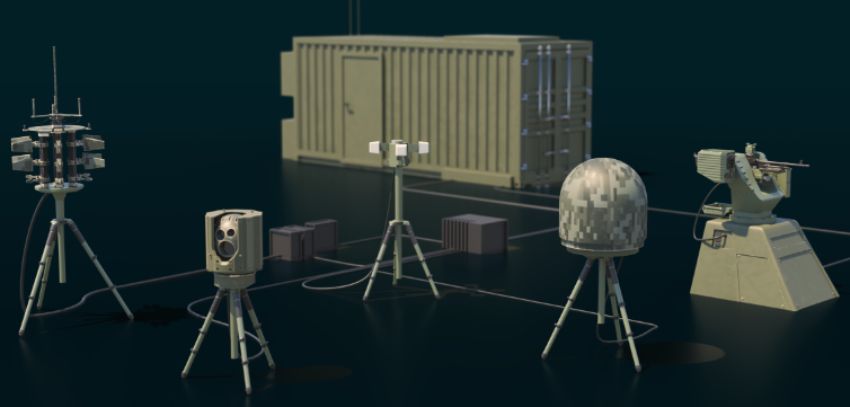 Indra Group Counter-UAS System
Delivering on Europe’s ambition for strategic autonomy requires committed industrial actors, and Indra Group is playing its part. We contribute to essential capabilities through more than 70 European Defence Fund projects - from command and control to air and cyber defence - while maintaining a leading position in European air traffic management. Alongside our growing alliances with key industrial partners, these efforts strengthen not only Indra’s role, but also Europe’s broader drive for strategic autonomy.
As Europe moves into a decade of geopolitical uncertainty and rapid technological change, strengthening alliances and accelerating joint capability development will be key. Technological sovereignty is democratic sovereignty, and Europe must act with ambition and consistency to build a more competitive defense industry.
Achieving this vision will require sustained cooperation, shared investment, and strong European industrial leadership. From Indra Group we stand ready to contribute. Achieving strategic autonomy will require robust government-to-government frameworks and sustained commitment. The path is clear: Europe’s security will depend on cooperation, shared investment and industrial champions capable of delivering it.
Sign up to The Parliament's weekly newsletter
Every Friday our editorial team goes behind the headlines to offer insight and analysis on the key stories driving the EU agenda. Subscribe for free here.