Lobbying in Brussels is a delicate business. Yet even as U.S. President Donald Trump has degraded transatlantic relations — launching a trade war, questioning Europe’s commitment to NATO and floating a Greenland takeover — American interests continue to enjoy extraordinary access to EU policymakers.
Europe’s longstanding ties to Washington, combined with the vast resources and networks of U.S. companies, trade groups and institutions, have long given U.S. actors an unrivaled presence in Brussels. New data suggest that influence hasn’t only endured under Trump, but is growing.
To understand how U.S. actors are advancing their agenda, The Parliament analyzed lobbying activity using open-source intelligence compiled by MEP Analytics, a Brussels-based AI intelligence firm.
Since Trump’s inauguration on Jan. 20, U.S. organizations have held around 2,500 formal meetings with 431 European lawmakers — roughly 60% of the European Parliament. Big Tech and IT companies accounted for the largest share, recording 699 meetings with 243 MEPs. Lobbying by leading U.S. tech firms rose 20% from a monthly average of 37.1 Parliament meetings at the end of the Joe Biden administration to 44.5 in Trump's second term.
The five largest U.S. tech companies — Google, Apple, Amazon, Meta and Microsoft — collectively held more meetings with MEPs than the U.S. Mission to the EU and the American Chamber of Commerce combined.
The figures are drawn from publicly available data from the European Parliament Transparency Register, the Council’s public register, the Commission’s Cellar database, and the press services of both the Parliament and the Council.
1. Big Tech lobby outpaces diplomatic missions
Since Trump returned to office, U.S. lobbying activity in the Parliament has grown by roughly one eighth. Much of the increase is driven by Big Tech firms, while some diplomatic outreach has slowed.
Five tech companies alone — Google, Apple, Amazon, Meta and Microsoft — held 458 meetings with 206 MEPs. By comparison, the American Chamber of Commerce to the European Union logged only 101 meetings during the same period, while the Mission of the United States to the European Union held a mere 46 meetings with MEPs since the start of Trump 2.0 — a 37% lower monthly average than under the last stretch of the Joe Biden administration. Data was examined only since July 2024 to reflect the Parliament’s new mandate.
The dominance of Big Tech stands out: the five largest U.S. tech companies outpaced traditional U.S. diplomatic channels by nearly three to one in meetings held and roughly two to one in MEPs reached. The record level of outreach reflects a broader surge in lobbying expenditure by tech firms, which a recent study estimated at around €151 million annually.
That’s perhaps unsurprising, given that U.S. technology companies have fiercely opposed key EU digital regulations — notably the Digital Markets Act and the Digital Services Act.
Still, some diplomatic channels upped their outreach to EU representatives. The U.S. embassy and the consulate network saw their meetings rising 130% under Trump, while U.S. federal agencies like the U.S. Trade Representative and Department of Commerce saw a similar 100% jump from a low base.
Diplomatic channels are increasingly being used to amplify corporate interests, analysts say. “What is really new in this mandate ... is that now the U.S. administration is extremely vocal about asking the EU to deregulate, especially in the tech sector,” said Raphaël Kergueno, a senior policy officer at Transparency International.
Andrew Puzder, the U.S. ambassador to the EU, has routinely echoed Trump’s calls to scrap the bloc’s digital rules, claiming the laws discriminate against U.S. firms and undermines freedom of speech.
2. Right-wing parties are sidelined
While more ideologically aligned with the current U.S. administration, far-right MEPs haven’t been the main target of U.S. interests.
According to MEP Analytics, while right-wing Patriots for Europe (PfE), European Conservatives and Reformists (ECR) and nationalists from Europe of Sovereign Nations (ESN) hold 27% of seats in the Parliament, they only received 11.8% of U.S. outreach. At the same time, the center-right EPP, Socialists from S&D, liberals from Renew and the Greens hold 62% of parliamentary seats but accounted for 86% of meetings with American companies.
As the bloc’s largest group, the EPP alone gets 35.6% of meetings. EPP lawmakers are more likely to be targeted as they occupy some of the key seats in committees whose remits U.S. companies are keen to shape.
But when it comes to Big Tech, Kergueno said there’s more to it than just parliamentary roles. “S&D is also a very large group and we don’t actually see as much engagement with Big Tech companies, so there’s also a bit of a choice of who to engage with,” he said, pointing to an “alignment” with the EPP on the deregulatory agenda, currently a key priority for the Big Tech.
However, there’s an exception to the low engagement with the far-right. Bram Vranken, researcher at Corporate Europe Observatory, pointed to an increase in meetings between Meta and far-right MEPs, to the extent that, between December 2025 and January 2026, Patriots for Europe emerged as the group the American tech giant engaged with the most. “My expectation is that Meta in particular is gaming on the fact that the EPP is at times working together with the far-right to pass certain deregulatory initiatives,” said Vranken.
3. Who speaks to the U.S. the most?
Among the MEPs that met the most with U.S. companies, one has caught the attention of civil-society organizations concerned about conflicts of interest.
According to MEP analytics, Aura Salla (EPP, FI), formerly Meta’s Head of EU Affairs in Brussels, is the 13th most-met MEP by American companies, logging 23 meetings with 21 distinct U.S. firms in 16 months.
In February, seven watchdog organizations published a letter to the ITRE committee coordinator, arguing that Salla should have declared a possible conflict of interest due to her previous stint as a lobbyist for Meta when appointed as Rapporteur for the Digital Omnibus — the regulation aiming to simplify EU data rules, including changes to the General Data Protection Regulation.
Declaring a possible conflict of interest would have triggered a vote in the ITRE committee, Vranken said. “She might have passed that vote, but at least it would have been discussed openly that she has a past as a Meta lobbyist and that now she will be in charge of digital deregulation, something which Meta has been aggressively pushing for.”
Salla denied any wrongdoing, writing in an e-mail to The Parliament that “everything has been done transparently, all information is public and done according to the Parliament’s rules.” She added that all her meetings with companies are in the transparency register, that she sold all her stocks in Meta when elected to the Finnish Parliament in 2023 and hasn’t had any ties to the company since.
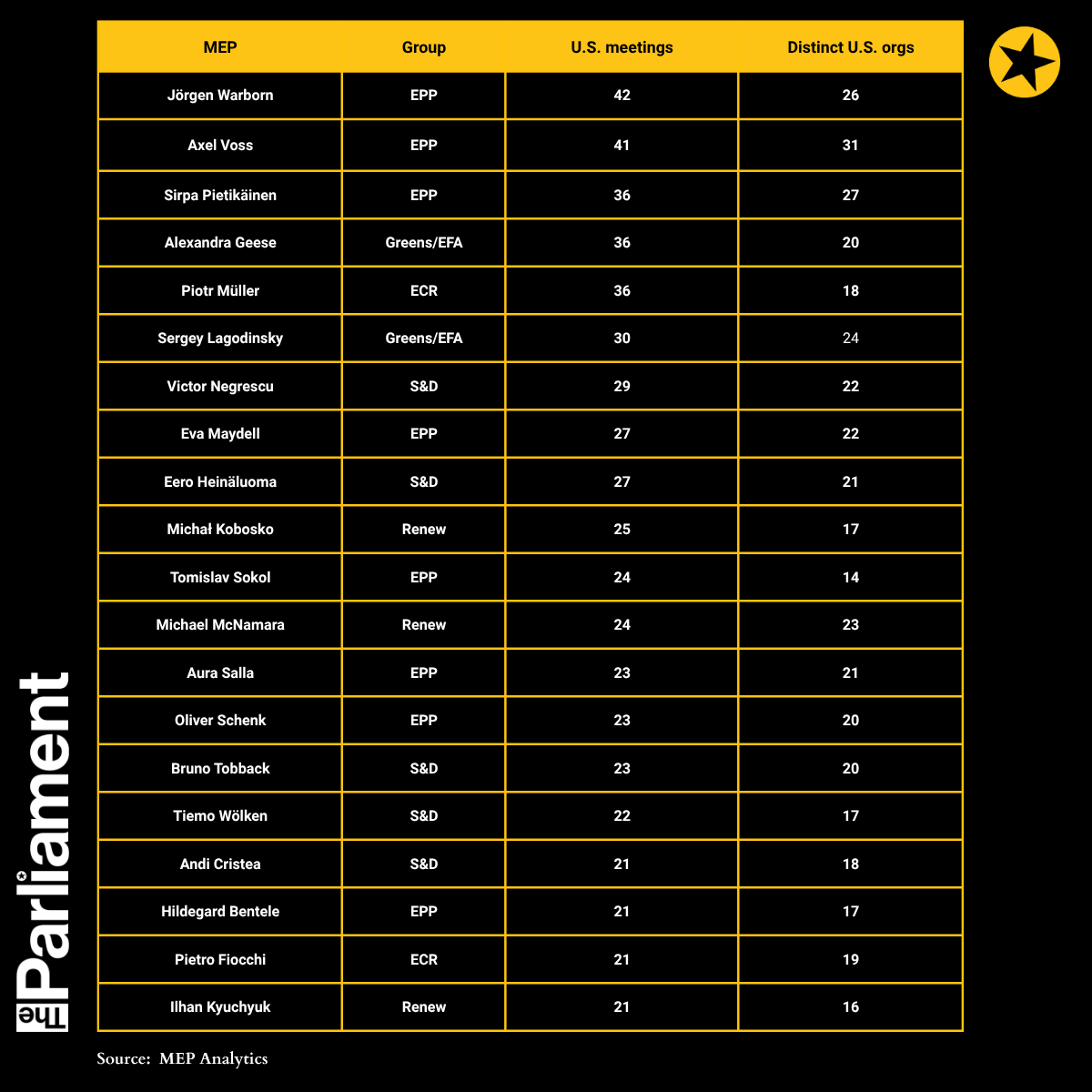 Top 20 MEPs by U.S.-attributed engagement.
4. Not just lobby groups
Big Tech companies optimize their influence by funding think tanks, NGOs and organizations. “You have your own lobby meetings,” Kergueno said. “But if you are smart in Brussels, then you have your trade and business association try to push for positions there to the Commission, you have think tanks that can push your position.”
However, U.S. organizations in Brussels aren’t just attached to Big Tech lobbying. An emerging network of MAGA-aligned think tanks in Brussels is also campaigning against the EU’s digital regulations. American anti-gender and anti-abortion organizations, like Alliance Defending Freedom and the Heritage Foundation, are becoming “more and more present in Brussels, especially since Trump is in office,” said Vranken.
5. The Parliament has never talked this much of Washington
With Trump back in office, EU policymakers are talking about the U.S. more than ever before. According to a speech analysis by MEP Analytics, mentions of the U.S. in speeches by both the European Commission and the Parliament have tripled. In the European Council, which represents EU member states, references to the U.S. have doubled over the same period.
Sign up to The Parliament's weekly newsletter
Every Friday our editorial team goes behind the headlines to offer insight and analysis on the key stories driving the EU agenda. Subscribe for free here.