On April 21st at Press Club Brussels Europe, finance policymakers, insurance business leaders, NGO representatives and risk management executives gathered for “Insurers as key Players in the Savings and Investments Union?”, organised by Aéma Groupe and hosted by MEP Sirpa Pietikäinen (EPP, Finland).
In 2023, European households held €37 trillion in savings. A staggering €10.6 trillion of it lies in insurance and pension-related products - capital that could, in theory, be mobilised to fund Europe’s green and digital objectives, as well as infrastructure and defence priorities.
Few in the room disputed the scale of the opportunity. The insurance sector, long regarded primarily as a risk manager rather than a strategic investor, is increasingly seen as one of the missing pieces in Europe’s investment architecture. The question animating the day was not whether insurers should play a greater role, but how to make it happen.
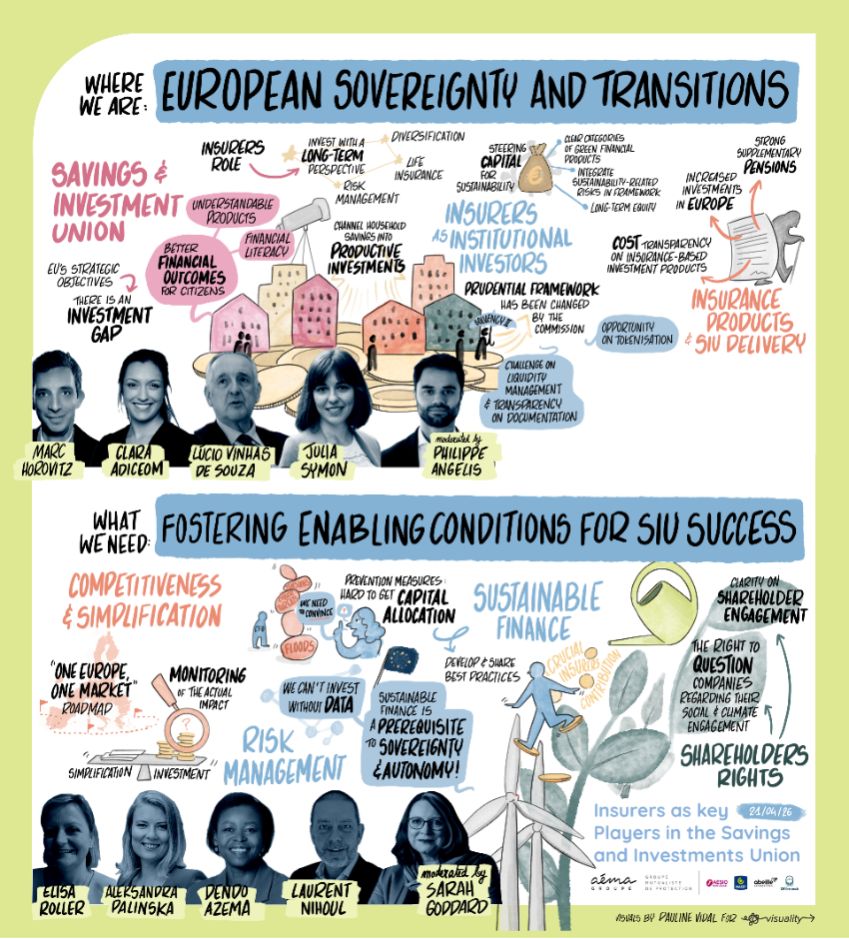
Marc Horovitz, Deputy Head of the Insurance and Pensions Unit at DG FISMA, the hard work from the European Commission is largely done. In recent years, it has rolled out a series of financial reforms to unlock capital - most notably the Solvency II revision and the EU Taxonomy - designed to create the conditions for long-term institutional investment. The message from Brussels was clear: the framework is in place, and the ball is now in the industry’s court.
Insurers, however, tell a different story. While welcoming the reforms, industry representatives argued that the current regulatory framework still imposes constraints that limit their ability to invest at the scale required. Capital requirements under Solvency II, in particular, were cited as a persistent obstacle to equity investment.
For Clara Adiceom, Director of Life Insurance Strategy Deployment and Governance at Abeille Assurances, the core issue is liquidity: management restraints need to be loosened to free up more capital for long-term deployment. Despite this, she struck an optimistic note, pointing to the emergence of tokenisation and more transparent insurance products as genuine opportunities to unlock further investment in the years ahead.
Lúcio Vinhas de Souza, Chief Economist and Director of the Economics Department at Business Europe, also stressed that there is still a lot to be done by the Commission concerning financial system reforms at least until 2027, when its proposals arising from the upcoming report on the competitiveness of the EU banking system are to see the light of the day.
Regulation ensures predictability, a level playing field, and long-term prosperity
Beyond capital requirements, the debate also turned to the products through which retail investors engage with the insurance sector - and whether those products are truly fit for purpose.
Julia Symon, Head of Research and Advocacy at Finance Watch, acknowledged the value of existing products while pressing for improvements: more transparency, clearer cost structures, and rigorous sustainability testing are needed before retail investors can be meaningfully brought into the SIU picture. Adiceom offered a counterpoint, arguing that the industry conversation is too narrowly focused on cost. “There is too much focus on the cost of these products,” she said, “and not enough on the value they deliver.” The exchange underlined a broader tension: consumer protection and investment ambition are not always easy to reconcile.
The second panel introduced a sharper ideological fault line. The European Commission and industry representatives have both championed “simplification” of the regulatory framework as a means of reducing red tape and freeing up capital. But for many stakeholders, the term has become a cause for concern – given that it has been misused for watering down hard-won financial regulation.
Aleksandra Palinska, Executive Director at Eurosif, was direct: “If you’re asking whether simplification could weaken Europe’s leadership in Sustainable Finance, the answer is yes.” She went further, reframing the debate in terms of European sovereignty: “Sustainable finance doesn’t undermine Europe’s competitiveness. It is a prerequisite for Europe’s sovereignty and autonomy. It has become an important risk management tool.” Her remarks served as a reminder that the SIU is not being built in a political vacuum - and that the direction of travel on sustainable finance has implications well beyond the balance sheets of individual insurers.
Both panels closed with the same question put to speakers: what would a successful SIU actually look like in a few years’ time? The answers revealed as much about each stakeholder’s priorities as about the SIU itself.
Horovitz was measured, cautioning that two years would be too early to judge - but said he would expect to see “more capital flowing to infrastructure and innovation.” Elisa Roller, Director for Prosperity and Security at the Secretariat General of the European Commission, offered a two-horizon answer: in the short term, she wants the insurance sector to “step up” on climate-related investment; in the long term, she echoed Horovitz’s ambition for insurers to “invest long-term in Europe’s green and digital transitions.”
Tension emerged between industry and NGO voices. Dendo Azema, Responsible Investment Policy Officer at Aéma Groupe, defined success as a framework that would “safeguard policyholders’ savings from climate risk,” while Adiceom said she would measure progress by a meaningful increase in consumer investment. Symon and Palinska both struck cautionary notes, warning against any dilution of transparency and sustainability standards in the push to scale up.
A more expansive vision came from Vinhas de Souza, who argued that a genuinely successful SIU would require deeper integration of the EU’s single market and the creation of a Euro-wide banks to facilitate cross-border capital flows.
There is too much focus on the cost of these products and not enough on the value they deliver
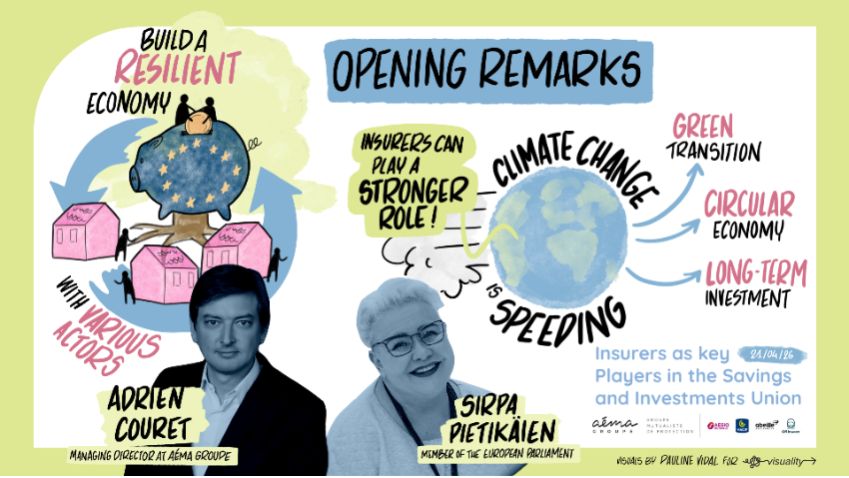
The day closed with remarks from host MEP Sirpa Pietikäinen and Adrien Couret, CEO of Aéma Groupe, the event’s organiser.
MEP Pietikäinen used her closing remarks to make a broader political point, calling on those who believe in regulation to make their voices heard more forcefully in public discourse: “Regulation ensures predictability, a level playing field, and long-term prosperity.” She closed with an invitation to maintain the momentum of the day’s dialogue - and to translate it into concrete progress on embedding the insurance sector into the SIU.
Couret ended on a more personal note. Speaking as a mutualist insurer, he ran through a four-item wishlist: further simplification of financing rules across member states; clearer signals on investment priorities, including the development of an EU industrial policy; better access to data beyond the current scope of the Corporate Sustainability Reporting Directive (CSRD); and, looking further ahead, a potential Solvency III review to align the cost of capital with climate resilience risk.
He framed each item not as a demand, but as a dream. Because, as he put it, “even insurers have them.”
Sign up to The Parliament's weekly newsletter
Every Friday our editorial team goes behind the headlines to offer insight and analysis on the key stories driving the EU agenda. Subscribe for free here.