NARVA, Estonia—In February, Russian social media accounts began circulating claims that a pro-Kremlin separatist movement was emerging in this Estonian city on the border with Russia. It was a narrative that quickly spread to local and international media.
But on the streets and in the bars of the industrial city of 52,000, residents who spoke to The Parliament brushed off the claims as bogus.
“There’s no separatism here,” said a visibly frustrated waiter at the popular Russian restaurant just steps from the Estonian side of the border crossing.
Perched on the banks of the fast-moving Narva River overlooking the Russian city of Ivangorod, Narva has long occupied a sensitive place in Europe’s security imagination. That made it fertile ground for a hoax that tapped into existing fears about Baltic security and hybrid warfare.
The episode is a case study in how modern disinformation moves: from fringe digital channels into local headlines and eventually mainstream European media, with responsibility shared from Moscow to Kyiv.
To misinformation experts and Baltic diplomats, it’s also a warning that Europe needs to inoculate itself against media manipulation — in part by better understanding the real Baltic security and economic situation — or risk being part of the problem.
Meelis Oidsalu, a former official in the Estonian Ministry of Defense and editor of the Baltic Sentinel, described the public mania and desire for sensational narratives as a kind of "scenario porn." In Narva, he said, "you will not meet loads of people who actually want to join Russia.”
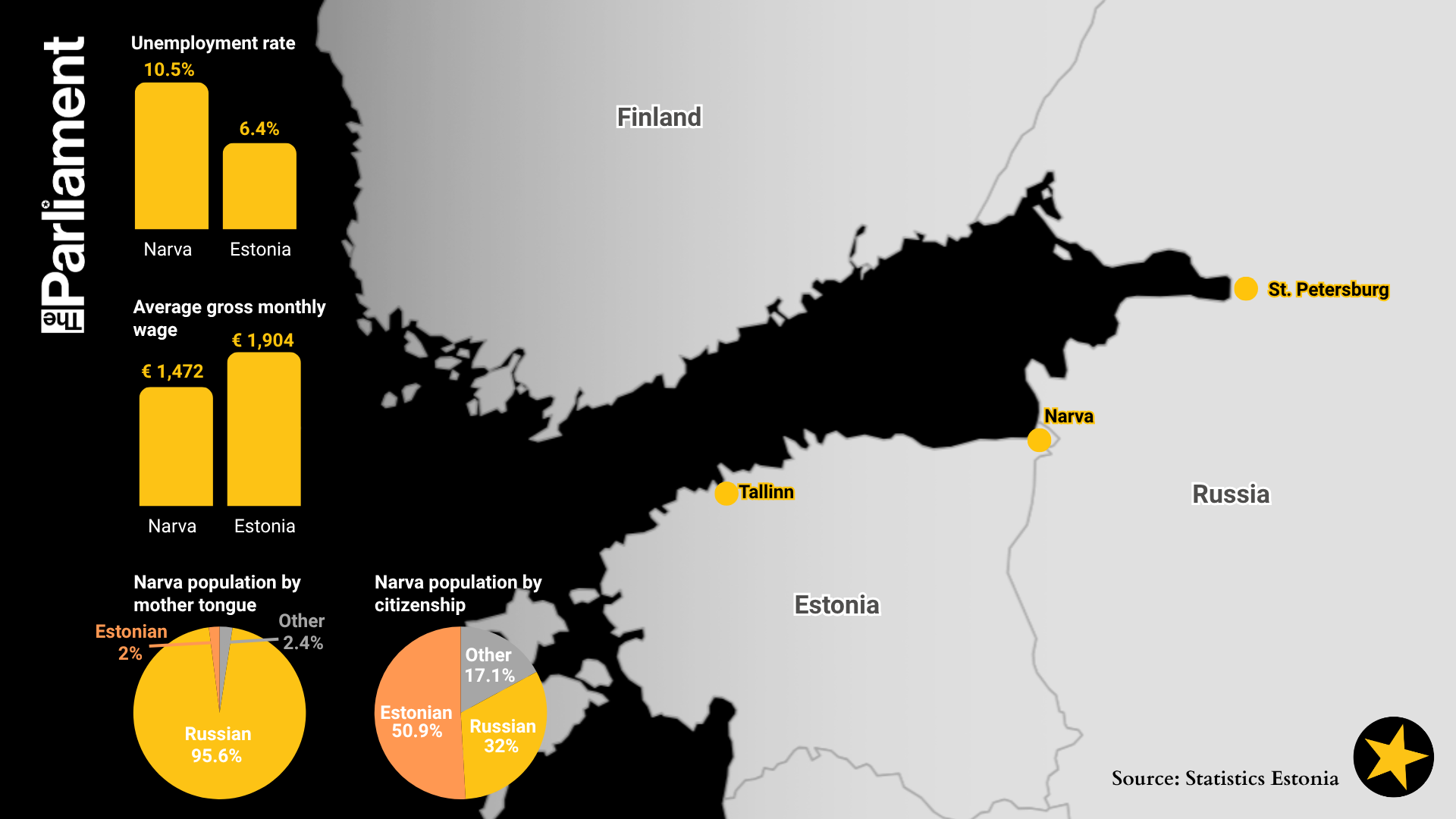 Chart by Margherita Dalla Vecchia
European media spreads Narva hoax
It started in St. Petersburg, where a Russian man created a Telegram group named the “Narva People's Republic” in an attempt to rile up separatist sentiment. The channel posted inflammatory content ranging from memes featuring a Narva flag-wielding cat to an agenda for the takeover of the city.
The activity was first noted by Propastop, an Estonian government-funded counter-disinformation blog, whose reporting was soon picked up by the local press. While early coverage treated the Telegram group as a credible threat, journalists from the Estonian newspaper Postimees eventually infiltrated the group and revealed the supposed “movement” boasted a mere handful of active members. The operation appeared designed to mimic the Russian-backed “People’s Republics” in Ukraine’s Donetsk and Luhansk regions — drawing on its language and symbols to suggest a genuine pro-Russian uprising where none existed.
But that flag-wielding cat was already out of the bag. Within days, journalists from Euronews, Deutsche Welle and Politico descended on the city. By the end of April, the Belgian chief of defense claimed that Russia had recognized a separatist movement in Narva, earning a rebuke from the Russian embassy in Brussels.
The issue has frustrated the city’s mayor Katri Raik, who has told media outlets it is a “spoiled herring” that merely distracts from the actual challenges facing Narva residents.
“The reality is that this whole idea of an irredentist secessionist movement is utterly absurd, given the differences on either side of the border” former Estonian president Toomas Ilves said. He argued that significantly higher average wages in Estonia, access to the EU and the threat of Russian military conscription leave little appetite for joining Moscow’s orbit.
“I think most of the ethnic Russians in Narva would shoot the ethnic Russians coming across the river,” said Paul Goble, a former advisor on Baltic affairs in the U.S. State Department. “Most people in Narva feel far closer to Tallinn than they do Moscow, even though they speak Russian.”
 (1).png) The Narva River between the Estonia city of Narva and Ivangorod in Russia. Narva, Estonia, April 2026. (Peder Schaefer)
The Narva River between the Estonia city of Narva and Ivangorod in Russia. Narva, Estonia, April 2026. (Peder Schaefer)
Vulnerability to Russian disinformation
“Russian propaganda is quite clever because it plays on narratives already there,” said Mārtiņš Hiršs, a Riga-based disinformation expert who helped write Latvia’s official government disinformation handbook.
In 1993, Narva and nearby communities held an unconstitutional referendum on regional autonomy that initially passed before being struck down by Estonian courts.
Though there’s no active separatist movement in Narva today, tensions with Tallinn do exist. As Oidsalu put it, “the conversion of Narva into an Estonian city is still a work in progress.”
Residents describe the shift from Russian to Estonian-language education as frustrating, and so are the long wait times at the Russian border. Even the Narva Museum recognizes the city’s divided identity, with one museum plaque stating that “many Narva residents are still torn … and cannot decide on which side of the Narva River their values truly lie.”
The city’s economic anxieties run just as deep. Narva has long relied on shale oil production and trade with Russia, both of which have been hit hard since Moscow’s invasion of Ukraine. Freight traffic across the border has largely stopped, while energy company Eesti Energia recently announced the closure of a shale oil quarry. In Ida-Viru County, where Narva is located, 10.5% of the population was unemployed in 2023, compared to the national average of 6.4%.
“It’s important to have good jobs and salaries in a region that's at the end of the EU,” said Teet Kuusmik, a board member at the Ida-Viru County investment agency, who called for increased EU investment in the region, such as the Neo magnet factory that opened in 2025 after receiving €14.5 million in EU funds.
Russian, Ukrainian and Baltic security narratives
The ‘Narva is next’ narrative has taken on a life of its own, with Russia, Ukraine and even Baltic governments finding ways to use it to advance their own interests, according to Mārtiņš Kaprāns, a sociologist at the University of Latvia focusing on Russian disinformation.
The story plays into the hands of the Kremlin, according to the most recent report of the Estonian Internal Security Service. Such campaigns are designed to undermine the country’s internal stability and, Russia counts the mere aplification of those narratives by mainstream media as a victory.
Paradoxically, Ukraine can also capitalize by emphasizing the acute need for more European aid. Ukrainian media outlets were among the first outside Estonia to amplify the Narva hoax. “We have a feeling that Ukrainians sometimes use us as bait for gathering some additional support,” Oidsalu said.
Ukrainian President Volodymyr Zelenskyy joined the chorus in recent weeks, warning that Russia could be gearing up for an attack on the Baltics. Estonia politicians pushed back, saying the comments echoed the Kremlin's messaging.
The story also has a domestic value for security hawks in Estonia and across the Baltics. After Russia’s full-scale invasion of Ukraine, Estonia used a “we will be next” narrative to boost a sense of urgency and drive up defense spending, according to Helena Eglit, a research fellow at the International Centre for Defense and Security in Tallinn. “But now, we also need to think about how to balance this narrative because it can have a paralyzing effect on society.”
How 'scenario porn' spreads across Europe
For media outlets from the rest of Europe, the stories play on age-old fears that get clicks and views. “Europe is primed for these kinds of narratives,” said Ilves.
Narratives about Russian aggression are rife in both national media and popular culture. Headlines about threats to the Swedish island of Gotland, the Norwegian island of Svalbard, or even TV shows like the 2025 Finnish series Conflict, which depicts a Crimea-style invasion of ‘little green men’ on the Hanko Peninsula, blend fact and fiction — offering fertile growing ground for disinformation.
The BBC drama Third World War caused a stir a decade ago, with a depiction of a fictional pro-Russian separatist republic in the eastern Latvian region of Latgale. At the time, the mayor and city council of Daugavpils, the regional capital of Latgale, sent a letter to the prime minister of the United Kingdom to protest the BBC's depiction of their city.
“This kind of foreign attention prompts a deep emotional response in the Baltics because it builds on already existing fears,” said Kaprāns. “You play on these kinds of historical traumas, because there is this feeling of being betrayed. The Baltic states, no one was willing to save them in 1940. And there is this kind of feeling that we won't have any agency whatsoever.”
What Europe can learn from the Narva hoax
If the fallout of the Narva hoax is a testament to the importance of journalistic standards, it’s less obvious what role, if any, governments should play. Goble, the former U.S. State Department advisor, said that publicizing potential security threats keeps society prepared, a perspective shared by Propastop. “Over time, similar information operations will likely emerge both in Estonia and elsewhere in Europe,” Propastop shared in a statement provided by Andres Lember, a co-founder and board member of the organization.
But Hiršs said that such narratives should be ignored outright if they aren't based in fact. Some Baltic diplomats suggested that governments should merely monitor such narratives and only intervene when they start to spread rapidly, such as when a story jumps from domestic to foreign press.
Susan Lilleväli, the director of communications in the Estonian Foreign Ministry, said that the government had tried not to intervene directly, as “by narrating this story, you are part of a web that distributes misinformation.”
The clearest takeaway might be to re-think how Europe views both Narva and its residents. The image of a city caught between East and West is a powerful one, but conversations on the ground suggested something more quotidian: a modern European city grappling with familiar problems around language, identity and economic opportunity.
The ‘Narva is next’ narrative does the opposite, said Eglit, pushing the city towards backwater status and driving a wedge between the region and the rest of Europe. “These news stories don’t regard Narva citizens and residents as agents, but instead as objects of a geopolitical game.”
Sign up to The Parliament's weekly newsletter
Every Friday our editorial team goes behind the headlines to offer insight and analysis on the key stories driving the EU agenda. Subscribe for free here.