On June 18th, French presidential candidate Édouard Philippe traveled three hours east of Paris to Colombey-les-Deux-Églises, a small town of 661 people in north-eastern France. There, Philippe placed a French blue, red and white tricolor wreath on the grave of Charles de Gaulle: general, resistance leader, statesman and enduring symbol of French sovereignty.
But Philippe wasn’t just there to fête de Gaulle’s Frenchness. Later that day, he made a more surprising claim on the general’s legacy, publishing an essay on “The Gaullist moment of Europe.” In it he called for a “pact for a free Europe,” a clear attempt to elevate de Gaulle’s grandeur and gravitas from the French to the European level. In hindsight, perhaps Philippe should have laid a wreath in the European Union’s gold and blue, too.
It’s not just Philippe. Across Europe, the intellectual and political legacy of de Gaulle is undergoing a 21st century resurgence — but with a strangely European twist. Over the past year, eager pro-European online communities have coined the term ‘eurogaullism.’ In the hallways of the European Parliament and the European Union’s diplomatic arm, chatter about the general is on the rise. And this summer, a five-hour biopic celebrating “the great asparagus” — as de Gaulle was known in his youth — is a hit across France.
In the age of Trump, Europeans from across the continent and ideological spectrum are coming around to the idea that de Gaulle, and the uniquely French approach he brought to the transatlantic relationship, may have been right all along. To many, he offers exactly what Europe is missing today. His emphasis on independence from the U.S., strategic autonomy for European industry and the ability to project a distinct personality in world affairs resonate with leaders stretching from Meloni’s Rome and Merz’s Berlin, to, of course, Macron’s Paris.
But de Gaulle’s revival contains a historical and political paradox. The general was no European federalist. He spent much of his career defending French sovereignty and resisting the emergence of a technocratic, supranational EU. Can a statesman who devoted himself to the “grandeur” of France really become the intellectual patron of a stronger European Union today?
In that context, de Gaulle’s resurgence is also a resurfacing of the EU’s defining contradiction: how to deepen economic and political integration to wield greater geopolitical power while preserving the sovereignty of its member states.
“You know, what we need is simple,” said Jim Cloos, the Secretary-General of the Trans European Policy Studies Association and a former Luxembourgish diplomat who worked on the Maastricht Treaty. “It’s a Gaullist frame of mind for Europe. We need that if we want to survive as an actor in the world.”
+++
The de Gaulle everyone knows — the war hero, the resistance leader, the lone voice in the night — is the one presented in the de Gaulle biopic that has become the summer blockbuster. The two-part film chronicles de Gaulle’s resistance struggle between 1940 and 1944, casting him as the protector of France’s independence against German, British and American threats during the catastrophic war years.
This de Gaulle insists on speaking directly to the French people in his appeal of June 18, 1940, rallying them over the BBC in the dark days after the fall of Paris. He resists American plans to occupy post-war France and British attempts to marginalize him. He even seizes the islands of Saint-Pierre and Miquelon off the Canadian coast from Vichy France. The movie presents a man who, in the words of his biographer Julian Jackson, “saved the honour of France.”
 Simon Abkarian as Charles de Gaulle in the French film De Gaulle: Résistance (2026) (© Malgosia Abramowska)
But there’s another de Gaulle who matters more to Europe’s present predicament. After leading the Free French during World War II, de Gaulle returned to power between 1958 and 1969, establishing the Fifth Republic and navigating France’s early relationship within a nascent EU and Europe’s place in Cold War geopolitics. This de Gaulle wrestled with questions that feel strikingly contemporary in 2026: how a “European Europe” can become more militarily and industrially independent, where political legitimacy should reside at the European level, and how Europe could develop its own unique personality in a world dominated by the U.S. and Soviet Union.
De Gaulle’s views spanned almost every dimension of political life. Beyond his better-known emphasis on independence and French sovereignty, he believed in a strong state; the centrality of the nation to history and political legitimacy; a third economic way between capitalism and communism shaped by Catholic humanism; and the importance of a political Europe to French interests and to a balanced international order.
He translated those ideas into foreign policies that helped shape the geopolitical landscape Europe still inhabits — often in ways that ran counter to pan-European integration. In 1954, French Gaullists, together with Communists, refused to ratify the Treaty of the European Defence Community, killing an early attempt at European defense integration. In 1958, de Gaulle called for France to be placed on equal footing with the U.S. and Great Britain in a refashioned Atlantic Alliance. Over the following years, he guided France towards an independent nuclear deterrent. Then, in 1966, he pulled France out of NATO’s integrated military command structure.
At first glance, de Gaulle’s most ambitious forays into foreign policy can look like a French nationalist wishlist: a quest to restore Paris at the center of international affairs after a disastrous World War II. Even today, that legacy still colors perceptions of French diplomacy across Europe. “I see the struggle for even the younger generation of French diplomats to gain the trust of their European partners because they are seen abroad as very conscious of their national interests,” said Jacob Ross, a research fellow specializing in Franco-German relations at the German Council on Foreign Relations. “And that’s another legacy of Gaullism.”
But reducing de Gaulle to French nationalism misses the other half of his foreign policy project: his determination to build a political Europe.
De Gaulle backed the Treaty of Rome, signed in 1957. But he also believed that a Europe rooted only in economic cooperation and technocratic governance from Brussels could never give the continent “its own personality and point of view.” Central to his concerns was the idea of political legitimacy, which he believed could only flow through the nation state — a tension still embedded in the architecture of the EU.
“Supranational organizations have their technical value, but they do not have, they cannot have, political authority, and consequently, political efficacy,” de Gaulle wrote. Or as Jackson wrote, “his intuition that a European project built by technocrats would have difficulty in creating a durable sense of common destiny and collective identity seems more compelling today than it did 30 years ago.”
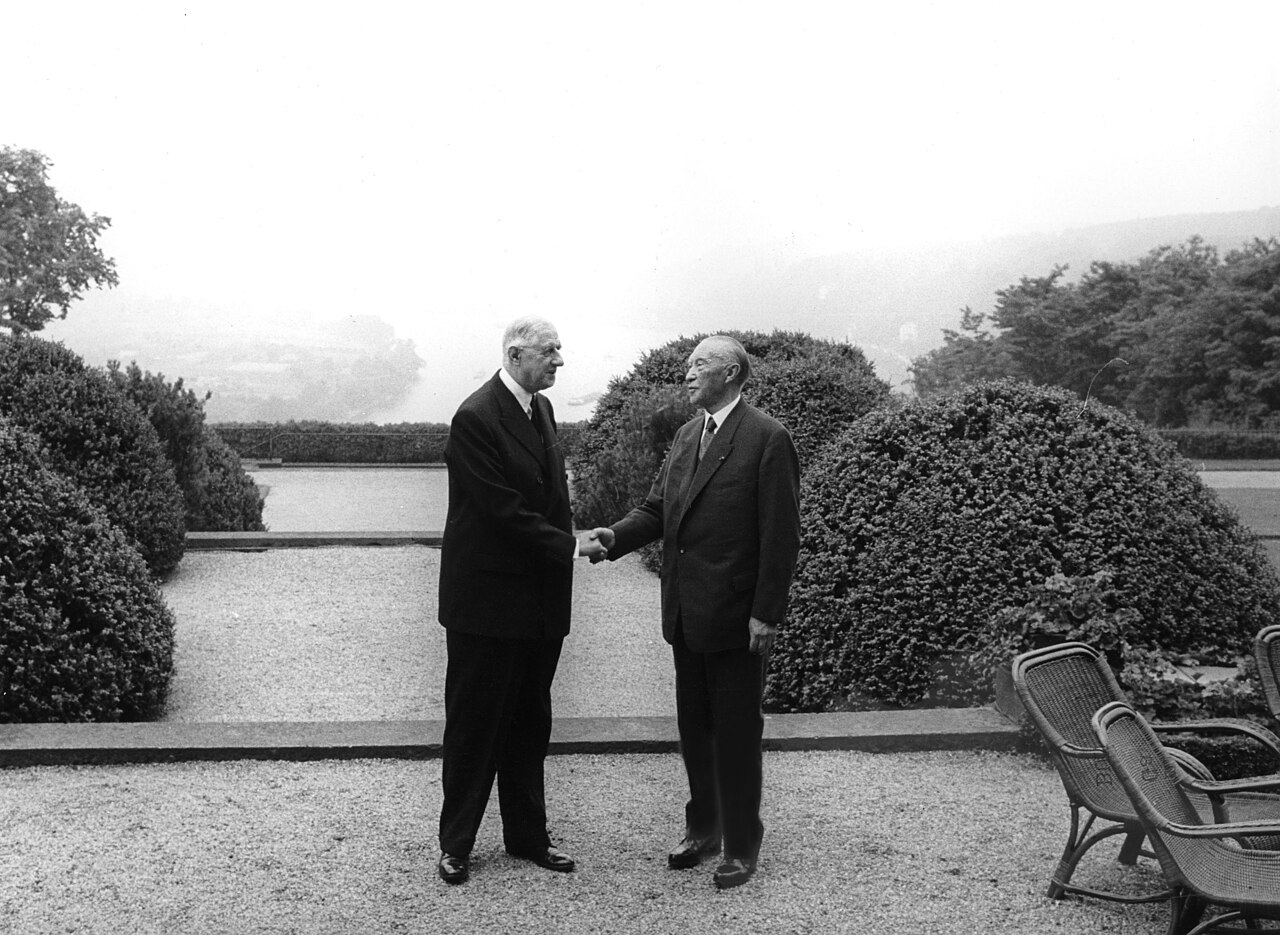 Charles de Gaulle shaking hands with German Chancellor Konrad Adenauer in Bonn in 1963. (Simon Müller / German Federal Archive)
In practical terms, de Gaulle proposed a political Europe to the six founding members in the early 1960s. “What de Gaulle had in mind was an institutionalized ‘concert’ of nations meeting regularly to discuss foreign policy and defence,” writes Jackson.
But French nationalism still left its mark. Historian Tony Judt, in his landmark history of post-1945 Europe, Postwar, wrote that “For Charles de Gaulle, the lesson of the twentieth century was that France could only hope to recover its lost glories by investing in the European project and shaping it into the service of French goals.”
For a moment, in early 1962, de Gaulle’s political Europe appeared within reach. Then the general overplayed his hand, trying to strip references to the Atlantic Alliance and NATO from the plan, according to Jackson. France’s European partners lost faith, and backed out of the first bona fide attempt at building a political Europe.
Yet beneath de Gaulle’s determination to center French interests and limit U.S. influence lay a deeper conviction that today’s eurogaullists can seize upon. Namely that European cooperation could, eventually, go much further.
In his memoirs, de Gaulle wrote that “It was my belief that a united Europe could not today, any more than in previous times, be a fusion of its peoples, but that it could and should result from a systematic rapprochement… From this starting point, there was every reason to believe that the process of evolution might lead to their confederation, especially if they were one day to be threatened from the same source.”
+++
Fast-forward to 2026, and everyone is touting de Gaulle. But rarely the same de Gaulle.
It wasn’t always this way. From the time of his death in 1970 through the decades of European integration in the 1980s and 1990s, de Gaulle was largely dismissed as a figure at the European level. Cloos, the Luxembourgish diplomat who worked within the European Council during those decades, said that “It was all Monnet, Monnet, Monnet during those years… de Gaulle was seen as not favorable to Europe during that period, which was completely wrong.”
Now his name is being tossed in Brussels with new fervor, driven in large part by the second Trump administration’s aggression towards Europe. An aide working in the European Parliament said “de Gaulle was right in the end” about the transatlantic relationship, and mentioned that among right-leaning pro-Europeans, de Gaulle had become a sort of hero figure. In the Parliament, meanwhile, growing discussions of “European preference” in defense and strategic industries ring a distinct Gaullist bell.
“De Gaulle’s intellectual legacy offers a path to all those in Europe — French or otherwise — who seek to address this challenge: deterring a continental threat while being unable to obtain clear guarantees from the U.S. ‘protector,’” said MEP Pierre-Romain Thionnet (PfE, FR). “De Gaulle had proposed a path in very clear terms: a ‘European Europe,’ whose member states must agree to acknowledge the divergences in strategic interests that exist between them and Washington, and equip themselves with the means and capabilities to avoid being subjected to any blackmail, pressure, or coercion from the U.S.”
The foremost French interlocutor with de Gaulle today — and the politician who has gone furthest in translating his ideas to the European level — is Emmanuel Macron. His official presidential portrait features a copy of de Gaulle’s War Memoirs lying open on the table before him, as if Macron were looking directly into the past for guidance on France's, and Europe’s, geopolitical future.
Many on the right see Macron as more internationalist than de Gaulle, closer to the so-called “Father of Europe” Jean Monnet. However, in a series of speeches on the future of Europe in 2017 and 2024, and more recently in remarks about expanding the scope of France’s nuclear deterrent to include European partners, Macron has repeatedly entered Gaullist terrain.
He has called for Europe to develop “autonomous operating capabilities” and declared that “we cannot blindly entrust what Europe represents [to] the other side of the Atlantic.” He has also pushed the idea of a more political Europe, proposing that more members of the European Parliament be elected on European-wide lists, and arguing that the continent should become a “third pole” in global affairs.
“Macron managed successfully to renew and modernize Gaullism by applying Gaullist principles to a European level,” said Ross. However, he added, “I don’t think he succeeded in finalizing this project.”
Europe still struggles to build joint defense projects, with the languishing joint German-Franco-Spanish fighter jet program being a prime example. It continues to buy American weapons. And member states still clash over the common capital markets and EU-wide business rules that could give the bloc the economic and political clout required for greater independence from the U.S.
The revival of Gaullist thinking isn’t confined to electoral politics. Online, a community of young right-leaning pro-Europeans has gone further, embracing the seemingly contradictory label eurogaullism.
“There are a lot of people in France who believe that Gaullism is about a strong France, but I think that’s an illusion,” said Odin, the young founder of the NXT4EU X account, which publishes primers on eurogaullism. “If France goes alone, then America will have more and more influence over us. And if de Gaulle hated anything, it was American influence over France, so I think he would have recognized that European cooperation would have been critical today.”
+++
For all the proclamations of Gaullist ideas by European leaders, however, the political choices Europe is making in the 2020s often fall well short of de Gaulle’s legacy.
“I think this interest in Gaullism is just a passing shadow and it won’t stay forever,” said Gregoire Roos, director of the Europe and Russia and Eurasia Programmes at Chatham House. “I think we are today in a kind of conceptual assertion. ‘I am Gaullist because it makes me feel like there’s a way out of this nightmare of infringed sovereignty.‘”
When the rubber hits the road, Roos argues, Europe’s leaders have shown little willingness to embrace the full implications of independence. Eurogaullism is attractive because it diagnoses Europe's problems, but it’s less obvious that it supplies workable solutions. Its greatest value may therefore be offered more in the form of a mindset rather than a policy program.
That mindset begins with an uncompromising quest for independence. Buying American military equipment, or even producing it on European soil, as Germany is considering, is “eurogaullism dying already,” Roos said.
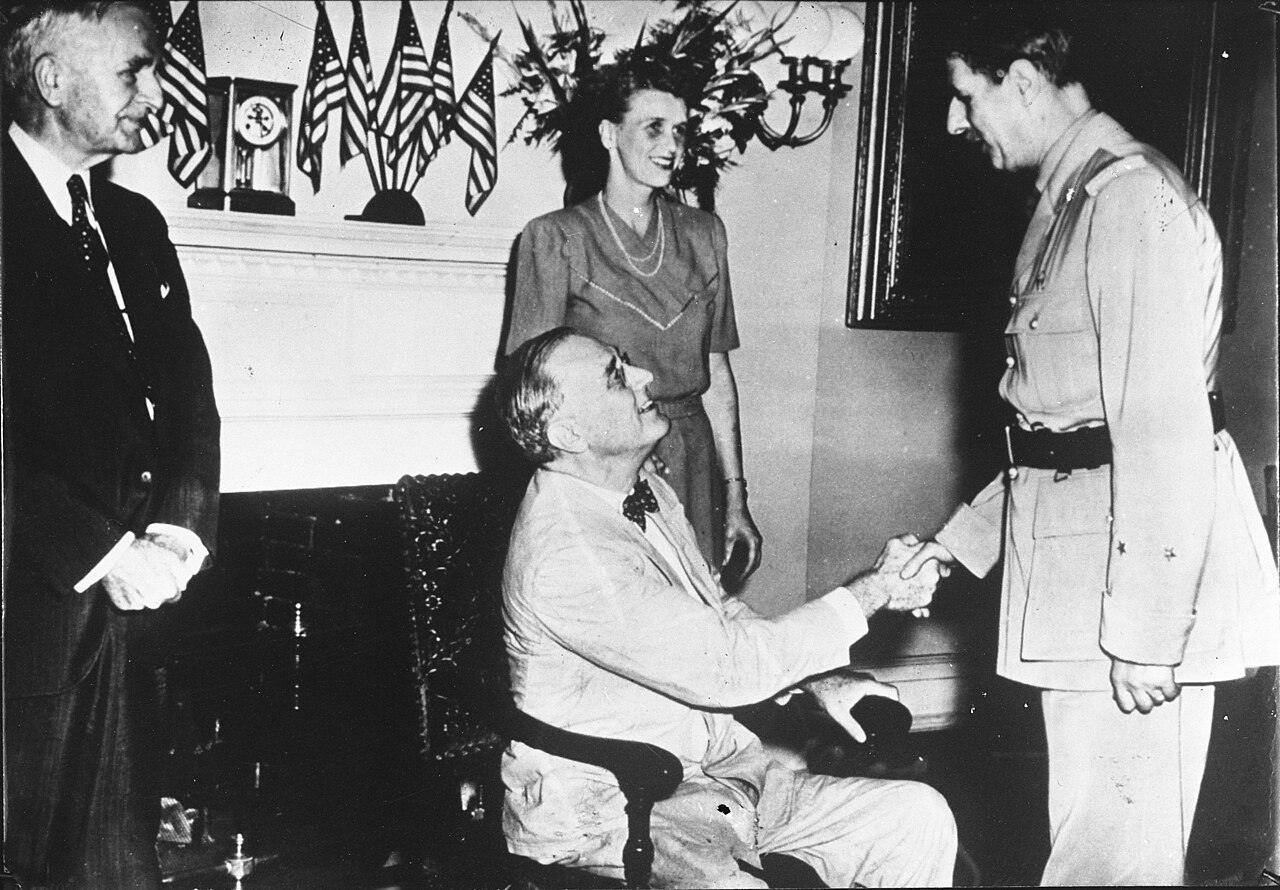 Charles de Gaulle met United States President Franklin Delano Roosevelt for the first time at the White House on July 6, 1944. (Anefo / Dutch National Archive)
A European army poses another problem. Proposals for common European defense, such as the 100,000-strong joint army advocated by Defence Commissioner Andrius Kubilius, collide directly with the old Gaullist balance between national sovereignty and European integration. Military procurement may offer a more practical starting point. “Applied eurogaullism is European preference in defense procurement,” said the Parliament aide.
The most consequential test, however, may be nuclear weapons. Under Macron, France has made efforts to extend the scope of its nuclear deterrence to other European countries. Yet this is also where the nationalist interpretation of de Gaulle’s legacy has done the most damage to those trying to modernize his ideas for the 21st century.
“The most striking part of the problematic legacy of Gaullism is about the strengthening of the European dimensions of the French nuclear deterrent,” said Ross. “There’s repeated mistrust about Macron reaching out on the French nuclear assets.” For example, many German civil servants and lower-level military planners remain suspicious of French motives, he said.
But a case can also be made that focusing too narrowly on individual policies misses the point. De Gaulle himself could be flexible when circumstances demanded it. It’s possible that faced with today’s strategic landscape, he would see the logic of a European army provided it answered to European capitals rather than Washington.
Andrew Hussey, a historian at the University of London, said that Gaullism was “whatever de Gaulle decided it was at any given moment,” a critique that could also be read as a celebration of Gaullist adaptability. De Gaulle himself, to a degree, agreed. He said once that “Everybody is, has been, or will be Gaullist.”
Sign up to The Parliament's weekly newsletter
Every Friday our editorial team goes behind the headlines to offer insight and analysis on the key stories driving the EU agenda. Subscribe for free here.