At the 2025 NATO summit in The Hague, allies agreed to raise defense spending to 5% of gross domestic product over the next decade. Since then, Spain’s claim that it can meet NATO’s capability targets while spending only around 2% has been met with skepticism across the alliance.
By the time leaders gathered in Ankara, Turkey, a year later, many allies seemed less focused on questioning Spain’s model than curious whether it could actually work.
Following another public clash with U.S. President Donald Trump over the Mediterranean country’s relatively low spending, Madrid doubled down on its opposition to the 5% target, arguing that its defense investments and modernization plans can remain fiscally sustainable without sacrificing social or environmental priorities.
According to a Spanish government document, Spain ranked seventh in total NATO defense spending in 2025 while strengthening both its fiscal balance and its deterrence capabilities. Raising spending to 5% of GDP, the document argues, would fundamentally upset that balance without necessarily delivering a stronger European defense.
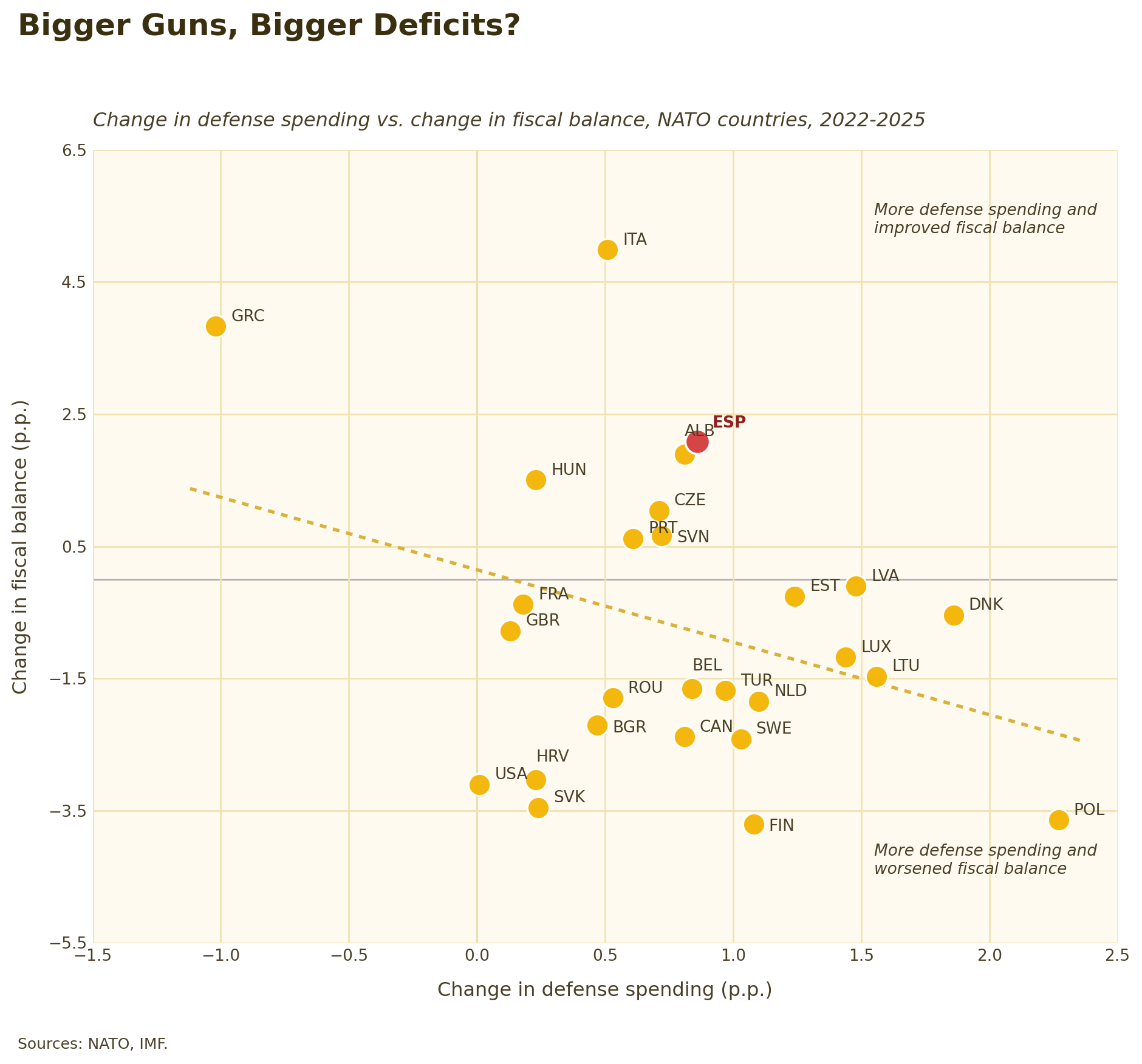
Analysts argue that Spain’s military transformation is real, but that it’s less a strategic overhaul than an expansion of long-term policy. Rather than rushing to buy munitions or build up stockpiles like NATO’s frontline states, Madrid is doubling down on existing modernization programs and capabilities.
"If we look at the current distribution of Spain’s budget and public spending, the largest share continues to go toward social programs rather than defense," said Alberto Bueno, political scientist at the University of Granada and member of the Spanish Research Group on Defence, Armed Forces, and Society.
To Bueno, however, the debate is about more than how much Spain spends. Regardless of the percentage, he said, the country lacks a plan for developing the deterrence capabilities required in the years ahead.
"We need a long-term vision of what we want to become, which areas should be prioritized, and a clear hierarchy of threats and challenges," he said. "From there, all of this defense investment could be directed accordingly, while accepting politically that there will be winners and losers in those adjustments."
A complex debate
Spain’s defense policy has drawn skepticism from NATO allies, but it has also required careful political management at home.
The challenge is keeping the government's left-wing coalition partners on board, and persuading a public for whom defense has rarely ranked among the country’s most pressing issues.
That political culture has shaped Madrid’s messaging. Rather than emphasizing military readiness, Prime Minister Pedro Sánchez has framed Spain's defense buildup as an investment in jobs, technology, innovation and European industrial cooperation.
One of the government's first defense measures was a pay raise for the armed forces, followed by the 2025 Industrial and Technological Plan for Security and Defence (PITSD), which committed €10.47 billion in new defense spending. Of this, roughly €2 billion was allocated to new defense and deterrence capabilities, with the remainder supporting areas such as personnel, cybersecurity, emergency response and defense-related research and industrial development.
Russia's invasion of Ukraine, growing uncertainty over the transatlantic relationship, and NATO's more ambitious spending targets have only reinforced the government’s framing of defense investment as an industrial and social policy. Under the PITSD, it argues, eight out of every 10 euros invested in defense will ultimately return to the Spanish economy.
For some critics, the government's economic case misses the bigger picture.
Juan Ignacio Zoido, a Spanish member of the European Parliament from the European People's Party (EPP), argued that the Sánchez government's approach is "short-sighted" and cannot be sustained without a national budget, something Spain has failed to approve since the 2023 budget.
"Defense generates research, innovation, highly skilled jobs and industrial development," Zoido said. "With proper planning, that economic dynamism ultimately generates greater resources for the welfare state."
He said the Spanish government has failed to make the broader strategic case for higher military spending.
"[Sánchez] has given up on his pedagogical work as a leader. He should not limit himself to explaining weapons procurement," he said. "He must also explain that we need to protect our airspace, respond to cyberattacks, secure our energy supply and prepare for emergencies."
Others see public opinion evolving, albeit slowly.
MEP José Cepeda (S&D, Spain) said there is growing awareness of the importance of defense, but many Spaniards still do not view Europe's rearmament plans as a means of deterrence and of protecting the continent's way of life and welfare state.
Although support for higher defense spending has grown, and more Spaniards say they feel under threat than in previous years, polling shows that defense still ranks well below concerns such as the rising cost of living.
For Guillem Colom, a professor of political science at Pablo de Olavide University, that is hardly surprising. In an article published in November 2025, he argued that Spain's historical experience and geography have long fostered a different strategic culture from that of many Eastern or Northern European allies. The country's relatively late integration into European defense structures after decades of authoritarian isolation fostered what he described as "a strong preference for multilateral legitimacy and internal stability," while leaving less room for public debate about high-intensity warfare.
Geography also reinforces that outlook. Perched at the crossroads of the Atlantic Ocean, the Mediterranean Sea and North Africa, Spain has traditionally viewed security through the lens of maritime surveillance, crisis management and broader concepts of comprehensive security rather than territorial defense.
Capability questions
Few defense analysts would dispute that military capability matters more than spending levels. The real question is whether Spain can generate the capabilities needed for today's — and tomorrow's — wars while spending significantly less than many of its NATO allies.
Military capability is more than buying tanks or armored vehicles, Bueno said. It also depends on logistics, maintenance, ammunition stockpiles, trained personnel and the industrial capacity needed to sustain military operations over time.
The first real test will come with NATO's midterm review in 2029, Bueno said. By then, allies should have a clearer picture of whether Spain's investment strategy has translated into deployable capability.
For now, much of the country's defense spending remains focused on inherited platforms and long-term modernization programs. A decade of austerity that lasted until 2018 left little room for investment into capabilities designed to meet the immediate demands of high-intensity warfare.
The subsequent modernization model has centered on technological sovereignty, European industrial cooperation and programs with long development timelines.
Colom described this trajectory as one of "advanced continuity." While politically and fiscally sustainable, it risks leaving non-frontline allies such as Spain only partially aligned with NATO's most pressing capability requirements, he said.
For NATO and the European Union, it begs the broader question of whether operational effectiveness is best supported by defense spending quotas.
To Colom, more useful indicators include delivery performance, stockpile replenishment, equipment availability and the speed at which investment translates into operational effectiveness.
Spain still faces challenges on that front. Zoido pointed to persistent gaps in areas such as integrated air and missile defense, drones and counter-drone systems, as well as cyber capabilities, and warned that the country remains too dependent on foreign suppliers.
Yet those benchmarks are evolving. Spain is expected to unveil a new National Security Strategy in the coming months, its clearest indication yet of where future investment will focus. But as Russia's war in Ukraine and conflicts in the Middle East continue to redefine military priorities, and emerging technologies transform how wars are fought, today's procurement decisions may struggle to keep pace with tomorrow’s battlefield. And that uncertainty extends well beyond Spain.
"The challenge posed by military artificial intelligence is enormous, and Europe is still out of the game," Cepeda said. "We don't have a European Palantir or anything with comparable capabilities.
"Unfortunately, the future of major conflicts will be shaped far more by technologies like these than by bombs alone," he added.
Sign up to The Parliament's weekly newsletter
Every Friday our editorial team goes behind the headlines to offer insight and analysis on the key stories driving the EU agenda. Subscribe for free here.