“The coming half-century will be a nuclear age, and France will play its full part in it.”
That is how French President Emmanuel Macron, standing before a nuclear-capable submarine on the coast of Brittany back in March, announced that his country's atomic arsenal would begin to play a more central role in protecting the territories of European partners — marking the most significant shift in France's nuclear posture since the Cold War.
After decades of ambiguity over whether France’s nuclear shadow could be projected beyond its borders, Macron's speech sketched a more assertive role for Paris in Europe’s deterrence as the United States shifts strategic attention to the Indo-Pacific, and as Russia and China expand their arsenals.
He also declared that France — the EU's only nuclear power — would increase the size of its nuclear stockpile and deepen nuclear cooperation with seven European states, including Germany, Poland, Sweden and Denmark. In May, Lithuania and Norway also joined the arrangement.
Under what Macron called "forward deterrence," Paris will maintain control over its force de frappe while drawing allied conventional forces into nuclear exercises and potentially deploying French nuclear-capable aircraft to partner states in times of crisis.
“It’s probably the most Europhile presidential speech ever,” said Astrid Chevreuil, a visiting fellow at the Center for Strategic and International Studies in Washington D.C. and a former French diplomat. But she added that the core tenets of France's nuclear doctrine, such as independent decision making, will remain. “It’s a big deal, but not a revolution.”
Macron’s speech also raised bigger questions about Europe’s nuclear future: Will the continent move towards a truly shared deterrence model, or merely closer collaboration with France still holding the trigger? And could this new nuclear era spur wider nuclear proliferation?
Europeanization of French deterrence
Macron’s speech builds upon an 85-year tradition of French nuclear doctrine rooted in independence, deliberate ambiguity and a recognition that France’s security is closely tied to that of Europe.
France first developed atomic weapons in 1960 under President Charles de Gaulle, who believed that the country needed a deterrent independent of the U.S. Since then, France has built an arsenal of around 290 warheads, four nuclear-powered ballistic missile submarines and a fleet of Rafale fighter jets able to deliver nuclear-armed missiles.
For much of the post-Cold War era, the emphasis was restraint. As recently as 2008, during a high point for the nuclear disarmament movement, France declared it would cut its nuclear stockpile by a third.
But Macron’s speech marked a reversal. Echoing De Gaulle’s language about an uncertain world, he said France would strengthen its nuclear forces and increase the size of its arsenal.
Macron also said France’s “vital interests,” the threshold that could justify nuclear use, have a clear “European dimension” extending beyond mainland France and its overseas territories.
Yet the boundaries of that protection remain deliberately vague.
Rafael Loss, a policy fellow at the European Council on Foreign Relations said that, for example, a military assault on Germany would almost certainly touch France’s “vital interests,” but that it's unclear whether that extends to more peripheral territories such as the Norwegian island of Svalbard or the Baltics.
“There's always been a French reluctance to specify what exactly are vital interests,” said Reid Pauly, an assistant professor of political science specializing in nuclear security at Brown University. “The strategic idea is not to draw the clear red line, because if you do that you’re signaling to the adversary exactly how far they can go.”
Where Macron did offer specifics was around his doctrine of so-called forward deterrence, designed to give practical meaning to the “European dimension” of France nuclear strategy.
Under the proposal, partners could participate in nuclear exercises. And France could conduct flyovers with nuclear-capable aircraft beyond its borders or even deploy nuclear-capable air forces to allied countries during times of crisis.
European countries quickly signaled interest. On the day of Macron’s speech, France and Germany issued a joint statement outlining steps to strengthen nuclear cooperation. Britain, Poland, the Netherlands, Belgium, Greece, Sweden and Denmark will also be involved, according to Macron, and Norway expressed interest in joining in the days after the speech.
Some experts believe the timing may also reflect domestic politics. With French presidential elections scheduled for April 2027 — and a growing likelihood that a far-right National Rally candidate could win the Élysée — Loss said Macron may be trying to lock in a nuclear doctrine that would be harder for a successor to reverse.
“Macron is eager to create what some political scientists would call path dependencies,” said Loss. “To bake in some of those decisions into European defense practices now before he leaves office, so that it becomes more difficult for a future French president to reverse back.”
Linking nuclear and conventional power
France and the United Kingdom are Europe’s only nuclear powers. Britain’s deterrent is embedded within NATO’s nuclear framework, while France’s arsenal has always been strictly national. Now, as doubts grow about U.S. security guarantees, that doctrine is evolving.
“This should not be seen as an alternative or competition to the American nuclear umbrella,” MEP Tobias Cremer (S&D, DE) told The Parliament. “Complementing the American nuclear deterrence with more European components is in everybody’s interest. The stronger that is, the clearer the signal to [Russian President Vladimir] Putin.”
Increasingly, Paris is linking its nuclear posture with the conventional military power — tanks, aircraft, and warships — of its European partners.
The goal is to push the nuclear threshold as high as possible, ensuring that any adversary faces a credible, unified response long before nuclear weapons would come into play.
But credible retaliation also requires the ability to penetrate an adversary’s defenses — an area where the continent still faces serious gaps. Air defense, deep-strike missile capabilities and early-warning systems remain among Europe’s most significant weaknesses.
Overall, Europe has enough military power to push back against a threat, said Paul van Hooft, a research leader at the RAND Europe think tank. But he argued the continent should invest further in deep precision-strike capabilities. Because these systems are non-nuclear, they could still provide powerful leverage against an aggressor, even if the U.S. were distracted by a crisis elsewhere.
Global nuclear proliferation?
European allies were largely supportive of France’s updated posture. Even in Washington, U.S. Under Secretary of War Elbridge Colby has argued for a “greater European complexion to NATO nuclear deterrence,” as independent European capabilities ultimately strengthen the alliance’s overall deterrence.
However, a report of the European Nuclear Study Group presented during the Munich Security Conference last month argued that developing more nuclear weapons in Europe would make the world less secure.
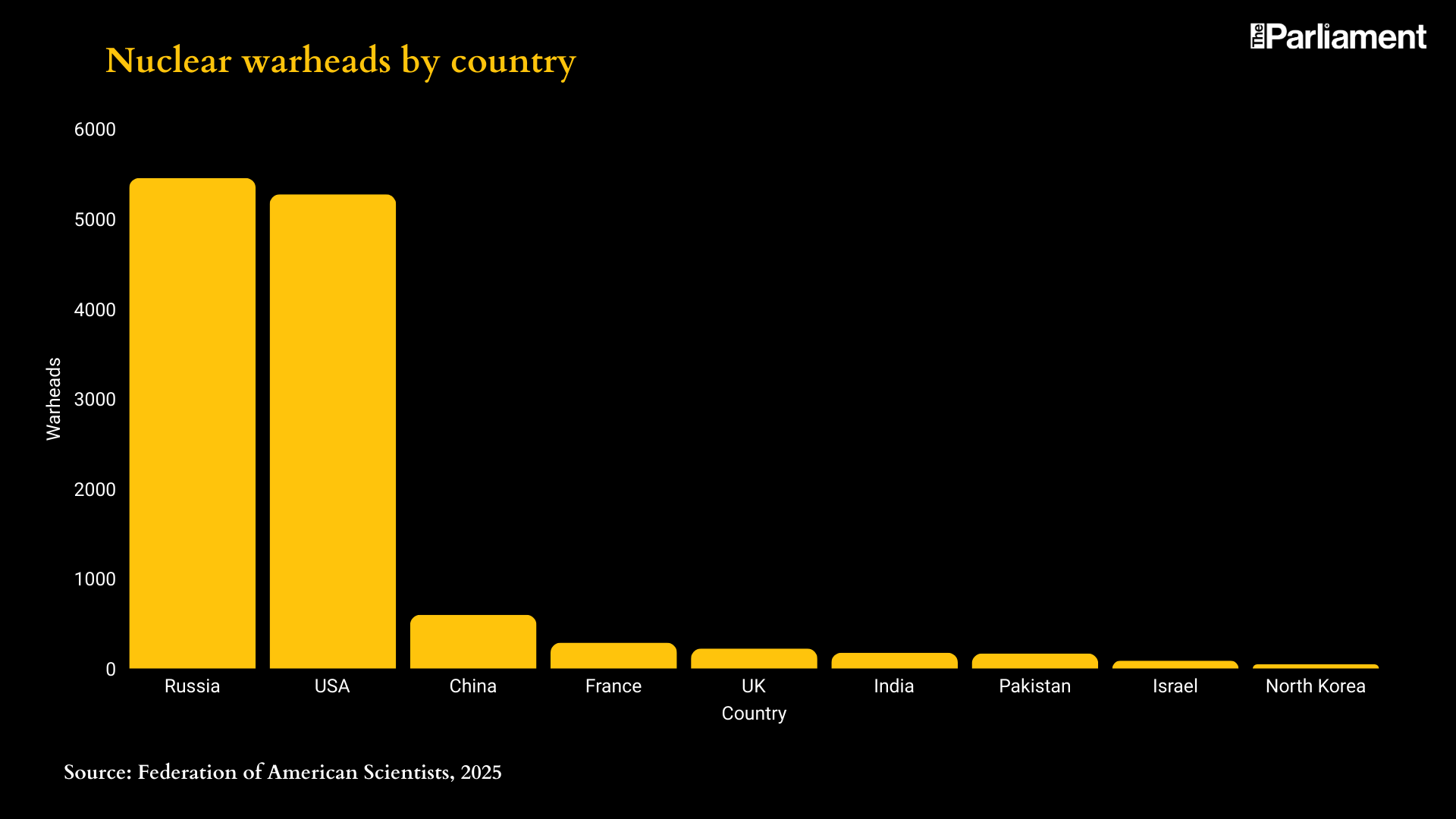
Proliferation, the authors said, would “reinforce global narratives of Western double standards,” undermine the continent’s credibility as a defender of the rules-based international order, and “potentially incite” other global powers to also follow their ambitions.
Polish Prime Minister Donald Tusk has already declared his country will eventually pursue its own non-tactical weapons.
“Nuclear proliferation is something that we should approach very carefully,” Cremer said. “We actually have a good nuclear umbrella. We should strengthen its European component.”
Under Macron, France has begun the Europeanization of its national deterrence. Whether others step under it — or the effort proves durable — will depend not just on Paris, but on Washington’s stance towards Europe and the readiness of Macron's partners to follow.
But whatever shape a European deterrent takes, Van Hooft said, one element must remain constant: “to keep building risk in the mind of the Kremlin.”
Sign up to The Parliament's weekly newsletter
Every Friday our editorial team goes behind the headlines to offer insight and analysis on the key stories driving the EU agenda. Subscribe for free here.