No country in the past 5 decades has been the source of crisis and tension in the region and the world as much as Iran. What is the reason and what is the solution?
Maryam Rajavi: The religious dictatorship in Iran does not belong to the twenty-first century. It is a medieval regime that has neither the capacity nor the will to respond to the demands of its people. The people demand its overthrow, and it can only survive through internal repression, the export of terrorism, and warmongering. We have always said this regime is unreformable and is seeking to obtain a nuclear bomb, and that if this regime were to abandon these policies for even one day, it would be rapidly overthrown by the Iranian people. More than two decades ago, I declared in the European Parliament that the solution for Iran lies neither in appeasement nor in foreign war, and I emphasized that appeasement would lead to war — something that has unfortunately come to pass today. Moreover, the current war and the one in June 2025 have shown that foreign war will not bring about regime change. The overthrow of this regime will be achieved by the people and the resistance.
When the regime falls, what will the next step be?
MR: The National Council of Resistance of Iran (NCRI), which is a coalition of democratic forces (opposed to both the Shah and theocracy), has presented a clear roadmap in previous years. The provisional government will begin its work immediately after the overthrow, within the framework of the NCRI's Ten-Point Plan. The main task of this government is to hold free elections for a Constituent Assembly within a maximum of six months. Subsequently, the provisional government will resign, and the people's elected representatives in this assembly will appoint a new government.
This assembly will draft the constitution of the new republic. The Council's Ten-Point Plan emphasizes free elections, individual and social freedoms, complete gender equality and freedom of women to choose their own attire, education and employment, separation of religion and state, autonomy for oppressed nationalities, the dissolution of the Revolutionary Guards and all repressive institutions, the abolishment of the mullahs' sharia law and the death penalty, a non-nuclear Iran, and peace and coexistence. The provisional government will guarantee
What actions is your resistance currently carrying out inside Iran and what role did it play in the January uprising?
MR: The People's Mojahedin Organisation of Iran (PMOI/MEK) is the principal component of the NCRI. It has an extensive network inside the country. The PMOI's resistance units carried out 4,092 anti-repression operations last year. On 23 February, 250 MEK fighters launched an assault on Khamenei's headquarters in Tehran, the most heavily protected area in all of Iran.
On 30-31 March and 4 April, six PMOI members, who along with many more of the organisation’s affiliates, had been sentenced to death, were brutally executed, reflecting the regime’s fear and terror of this resistance
The PMOI's resistance units played a key role in organising the uprising and directing its slogans. With their assistance, some cities or neighborhoods were liberated for several hours or one to two days. In many instances they led the fight against the repressive forces. They carried out 630 operations against the repressive forces to protect the demonstrators, which contributed greatly to the expansion of the uprising. Two thousand members of the resistance units disappeared during the uprising, and it is still unclear how many were arrested and how many were killed.
In recent days, four MEK members have been executed in Iran. What is the message of these executions?
MR: On 30-31 March and 4 April, six PMOI members, who along with many more of the organisation’s affiliates, had been sentenced to death, were brutally executed, reflecting the regime’s fear and terror of this resistance. These criminal executions, carried out in the middle of a war, show that the regime's primary concern is the uprising and the organised resistance inside Iran.
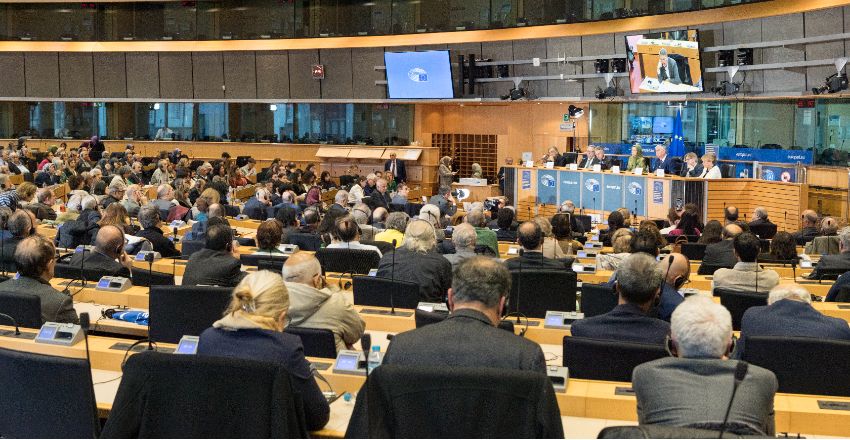 At the European Parliament, Brussels – December 10, 2025
If you look at the regime's judiciary statement on the execution of these six PMOI members, it explicitly states that they were involved in the uprising and working toward the overthrow of the system. Currently, a large number of political prisoners face execution on similar charges. The death sentences of several other have been confirmed by the regime's Supreme Court and they face execution at any moment.
What evidence is there of the Iranian people's support for the National Council of Resistance of Iran?
MR: While there is no possibility of a free public opinion survey, the first indicator of popular support is the extent of the resistance. The NCRI is the most enduring coalition in Iran's history, having continued its resistance against the regime for 45 years without a single day's pause. More than 100,000 members of the resistance have been executed.
We are not seeking to gain power or even a share of power. Our goal is to transfer power to the people
The NCRI based on PMOI's intelligence network in Iran has exposed the most confidential secrets of the regime, including the nuclear sites at Natanz, Arak and Fordow. None of this would have been possible without broad popular support. That is precisely why the regime's first demand from foreign countries is the restriction of the NCRI and the PMOI. All members of the movement, and even those who participate in its programmes abroad, are described by the regime as "mohareb," which, under the regime's law, can be punished by execution. The regime has organised an extensive demonisation campaign against the resistance at a cost of hundreds of millions of euros.
Why is Reza Pahlavi and a return to monarchy not an appropriate solution?
MR: He represents a deposed regime that ruled through the torture and killing of opponents and notorious secret police called SAVAK and his father fled the country as millions of Iranians chanted "Down with the Shah." Not only has he failed to condemn his father's crimes, he also has taken pride in them. His platform for the future is the restitution of monarchical dictatorship.
He labels oppressed nationalities as separatists and calls for their suppression. The Iranian people have shown through their demonstrations, with the chant "Down to the oppressor, be it Shah or Leader," that they are strongly opposed to any form of dictatorship — whether monarchical or religious. They want a government based on their own free vote.
Are you a candidate for the presidency in a reformed Iran?
MR: Today I think only of liberating my compatriots from the religious dictatorship. My main duty is to restore hope and trust in my compatriots and to heal the wounds that this anti-human regime has inflicted on our society. As I have repeatedly emphasised, we are not seeking power nor even a share of power. Our goal is to transfer power to the Iranian people.
More than 1,200 global dignitaries including former heads of government, ministers, Nobel laureates and lawmakers have endorsed the NCRI's provisional government and Maryam Rajavi's Ten-Point Plan
Sign up to The Parliament's weekly newsletter
Every Friday our editorial team goes behind the headlines to offer insight and analysis on the key stories driving the EU agenda. Subscribe for free here.