The 7th round of Thailand-EU Free Trade Agreement (FTA) negotiations wrapped up in early October 2025, before the 8th round early next year with several intersessional meetings already planned. While the talks are ongoing, one small but powerful product – canned tuna – has gained attention.
Concerns have been that lifting tariffs might spur a surge in Thai canned tuna imports. However, with EU consumption far outpacing domestic production, canned tuna remains an essential, affordable staple. The discussion should go beyond volume, emphasising quality, sustainability, and reliability to ensure Europe secures a trustworthy supply.
DG SANTE conducts regular inspections, and an increasing number of facilities in Thailand and Africa hold MSC Chain of Custody certification to supply the EU market
In 2023, the EU sourced over 33% of its tuna imports from abroad, but only 2–3% coming from Thailand. Meanwhile, a large portion of imports came from countries still operating under an IUU fishing yellow card.
By contrast, Thailand’s�fisheries maintain full traceability from vessel to can, adhering to standards such as GMP and HACCP. DG SANTE conducts regular inspections, and an increasing number of facilities in Thailand and Africa hold MSC Chain of Custody certification to supply the EU market. Raw tuna suppliers are either EU-compliant or no longer on the IUU list, with some catches sourced from EU vessels. As a result, European consumers can rely on Thai tuna as a high-quality, responsibly sourced choice.
To critics, the timing might be troubling. Thailand has just revised its fisheries law, and some conveniently linked it with sourcing from untraceable and illegitimate origins, illegal practices, and possible market disruption. Yet, the reality on the ground tells a different story.
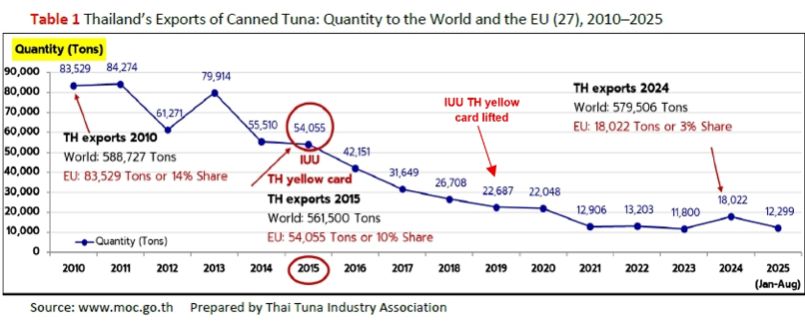
Thailand ratified ILO C188 in 2019, becoming the first Asian country to do so. For over a decade, it has worked closely with the EU to address IUU fishing and mitigate yellow card risks, establishing itself as one of the EU’s most reliable regional partners. Since 2015, regular policy dialogues and cooperative projects have helped bring Thailand’s fisheries sector in line with international standards.
Thai authority is working to link Thailand’s catch certificate with the EU’s CATCH system set to launch in early January 2026. Thailand’s 7 November 2025 amendment to the Royal Ordinance on Fisheries B.E. 2558 should not be seen as a rollback. Like all laws, it evolves with changing circumstances. By actively engaging domestic as well as international stakeholders, Thailand ensures open communication and demonstrates a strong commitment to preserving the progress achieved in combatting IUU.
Amid global trade uncertainties, both the EU and Thailand defend rule-based order
Amid global trade uncertainties, both the EU and Thailand defend rule-based order. In the FTA negotiations, Thailand and the EU are ensuring that fisheries’ competitiveness, sustainability and social standards are not undermined by trade liberalisation. The Thai-EU FTA will give European consumers direct access to high-quality, IUU-free, and affordable seafoods, including canned tuna, while enhancing food security across the continent.
For Europe’s fisheries sector, the deal also promises new investment opportunities which complement the EU’s tuna processors. In the end, working with a like-minded partner that values both sustainability and free trade policy like Thailand, is clearly a win-win for both sides and the global tuna supply chain.
In partnership with the Mission of Thailand to the European Union
Sign up to The Parliament's weekly newsletter
Every Friday our editorial team goes behind the headlines to offer insight and analysis on the key stories driving the EU agenda. Subscribe for free here.