It's the hardest time in decades to purchase or rent a home in Europe.
And that's down to the failure of many European Union member states to support public and social housing programs, Sorcha Edwards, the secretary general of Housing Europe, said in a recent interview.
Edwards, who leads a pan-European consortium for public, cooperative and social housing organizations across the EU, told The Parliament that the rise in prices was also having deleterious social consequences for low-income and young people.
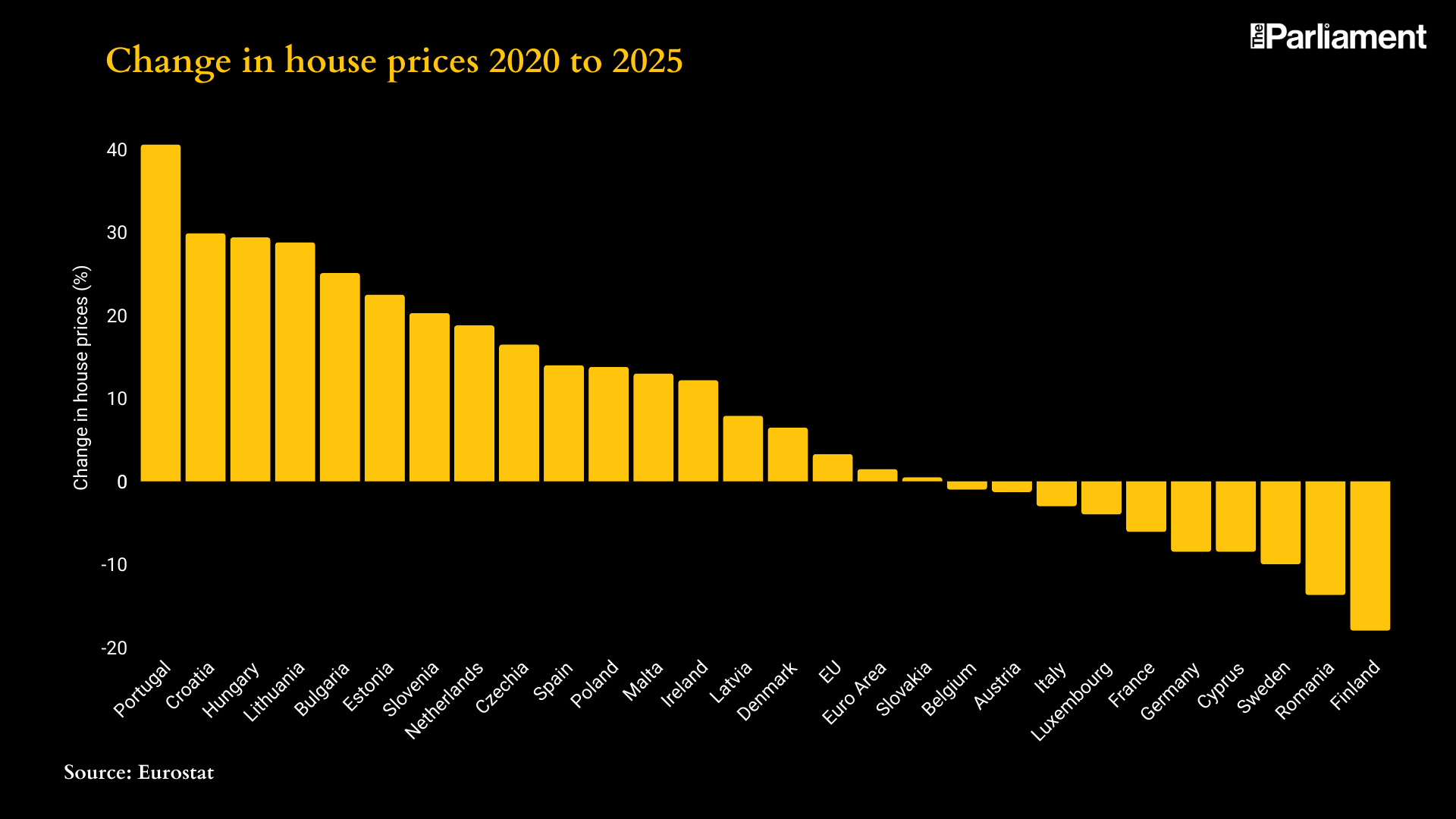
The headline figures are staggering; between 2015 and 2025, home prices across the EU increased by 60.5%. The EU needs 1 million more housing units than available. And over the past decade Europe’s homeless population has increased by 70% to nearly 1.3 million people, 400,000 of whom are minors.
"We've never seen anything like the amount of attention on the issue… It's a big moment, and what the EU decides now is critical," said Edwards. "Finally, Europe is pulling together an image of the root causes and forming a clearer picture of where the EU is pulling the strings and can actually help."
This article is part of The Parliament's special policy report "Addressing Europe's housing crisis."
The impact of the Great Recession
While the severity and roots of the housing crisis vary from country to country, housing experts have settled on a few sources of the crisis: stalled construction in the wake of the 2007-2009 global financial crisis, lack of investment in public and social housing, the rapid expansion in short-term rentals and an increasing number of homes bought as investments.
Construction permits for new homes across the EU dropped by 68% between 2006 and 2010, an analysis by the European Investment Bank shows.
Building a new home can require a decade in some European countries, meaning the drop in construction took years to translate into prices. In fact, European home prices initially fell in the early 2010s, as depressed demand kept prices low. Home prices only began to rise sharply in 2013, as demand began to recover and buyers had to compete for fewer dwellings.
But along the way, according to Edwards, European governments hollowed out the public housing authorities that could have been a corrective for the failure of market-driven approaches to quickly build more homes.
Recent housing complications
Construction was never able to fully recover. The COVID-19 pandemic and the subsequent Russian invasion of Ukraine have led to another drop in home construction permits of over 20% since 2021, as rising electricity costs have made building more expensive.
The troubles in the private housing market were exacerbated by a longer-term trend of privatization in the housing market, according to Edwards.
"There's been withdrawal from an active approach to making sure housing actually is aligned with needs, as opposed to only aligning with what the market will deliver," she explained. "We've given the market too much power for too long in too many member states."
All the while, demand for housing continues to rise in Europe. France has a need for 518,000 new housing units per year, while Germany needs 400,000 additional units each year, according to Housing Europe's report on the State of Housing in Europe 2025.
Public housing under strain
The lack of supply, increased demand and low production numbers are inducing record wait times for public housing in many EU member states. Nearly 2.8 million people are on public and social housing waiting lists in France, according to Housing Europe.
Predictably, the rise in prices has had the most significant impact on young people and low-income buyers. Homeownership rates for 24- to 35-year-olds decreased by 5.9% between 2005 and 2023, but fell by just 0.8% for the overall population, according to the EIB.
"There are a lot of hidden consequences that people often even don't talk about," said Edwards. "That results in young people not being able to study, start a family and being delayed leaving home."
Sign up to The Parliament's weekly newsletter
Every Friday our editorial team goes behind the headlines to offer insight and analysis on the key stories driving the EU agenda. Subscribe for free here.