IECAVA, Latvia — One year ago, this 30-kilometer stretch of land south of Riga was dense pine forest. Today, crews rip up stumps, carve access roads and comb the ground for unexploded ordinance left behind from World War II.
By August, Latvian officials hope to hold photo-ops here on a completed railway embankment.
This is Rail Baltica, a project meant to connect Estonia, Latvia and Lithuania to the rest of Europe and increase military mobility on the continent’s eastern flank. As one of the European Union’s flagship infrastructure efforts, it has already received €3.4 billion in funding from Brussels.
But Rail Baltica is also the most over-budget of all major EU-backed transport projects — weighed down by early cost estimates that proved far too optimistic. It currently faces a €10 billion funding gap. Sticker shock in Brussels is raising doubt about continued support in the next Multiannual Financing Framework for 2028-2034, even as the project stares down an EU-mandated 2030 deadline.
“It all depends on the MFF,” said Marko Kivila, the CEO of Rail Baltica, the transnational coordinating body for the project. “If the gap is too big, then it makes no sense for the Baltic States to push all that they have … delivery will depend on the availability of EU funds.”
The importance of Rail Baltica also goes beyond regional needs. It’s a case study for whether the EU can pull off the ambitious, cross-border infrastructure projects the continent needs to meet 21st century goals for climate, defense and transportation.
Budget strains threaten Rail Baltica
In 2017, the Baltic States agreed to build a high-speed rail line from Tallinn to the Polish border, advancing plans first proposed in 1994 to link the region to Europe’s rail network. The EU was set to fund 85% through the Connecting Europe Facility, its cross-border infrastructure fund.
The first capital expenditure estimates, completed by consulting firm Ernst and Young in 2017, put the total price tag for the project at €5.7 billion. That estimate has now increased to €23.8 billion. Even when controlling for inflation, it amounts to a 291% cost increase.
“The initial planning of the project was not as thorough as it should have been,” said Carlos Rico, a rail policy officer with Transport and Environment, a Brussels-based transport think tank that supports the project. He added that having multiple countries coordinate on Rail Baltica “might have been much tougher than anticipated,” especially considering the relatively low gross domestic national products of the Baltic states.
Kivila, Rail Baltica’s CEO since 2023, said the initial €5.7 billion estimate was “erroneous” and forced the project to start at an unreasonably low baseline. “If you take 900 kilometers of double-track railway, it should have been two or three times more expensive than €5.7 billion.”
In an effort to stay on track and manage the cost deficit, the Baltic states have split the project into two phases: the completion of a single track of the main line by 2030, and the later connection of Riga and Vilnius. This approach reduces project costs in the first phase from €23.8 billion to €15.3 billion — leaving a €10 billion funding gap.
As of the first quarter of 2026, 43% of the main line has funding secured, design finished and is ready for construction, according to Rail Baltica.
The heads of government in Estonia, Latvia and Lithuania re-affirmed their commitment to the 2030 deadline at a meeting in Tallinn on April 17, and Baltic diplomats in Brussels stressed that obtaining more Rail Baltica funding in the next MFF was one of their top priorities.
But until the next MFF is finalized at the end of this year or early 2027, it will remain unclear how much more money will be made available to keep construction moving.
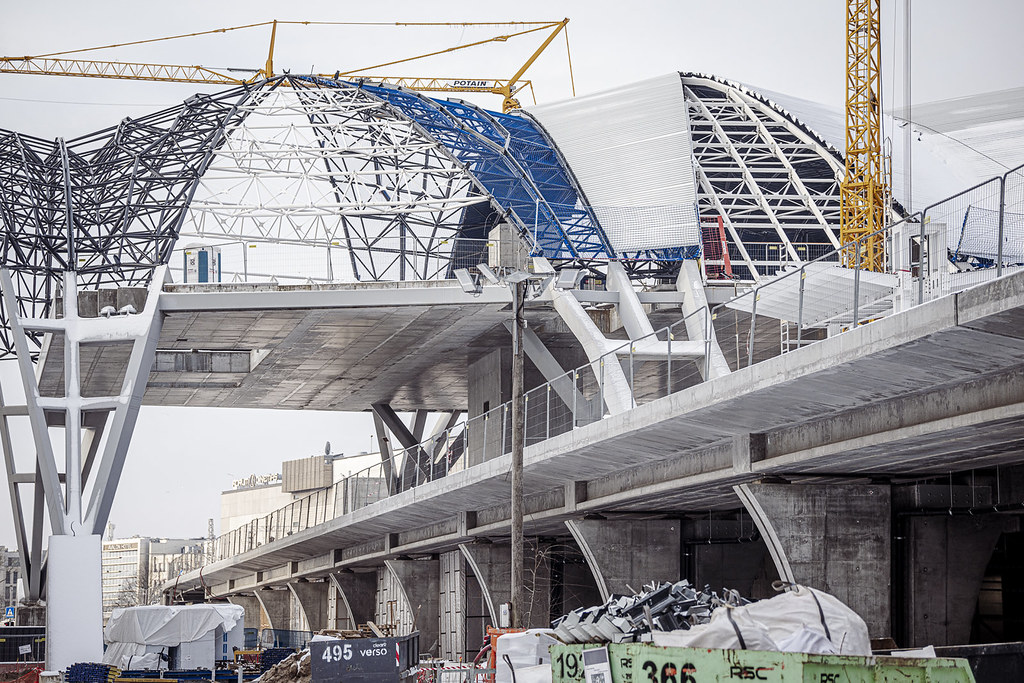 Riga Central Station construction in February 2026. (Rail Baltica)
Latvia delays progress
Of all the Baltic states, Latvia is the furthest behind in main line construction. The project is set to become a hot-button issue in October’s elections as the opposition in the Latvian Parliament have already launched investigations into potential mishandling and called for the project to be scaled-down. Meanwhile, Latvia is drawing criticism from neighboring countries for holding up progress.
“They're totally accurate,” Gatis Silovs, director of the government’s Rail Baltica Project Department, said when asked about the criticism. “We don't deny reality … a new team was made to work with this reality and to stop dreaming.”
Some missteps are evident. Latvia prioritized building new stations in central Riga and at the airport instead of focusing on core corridor connecting Estonia and Lithuania. With the shift to phased implementation, it’s now unclear when the main line will actually be completed to serve these stations.
Jānis Naglis, an executive board member for EDzL, the implementing organization responsible the project in Latvia, said early EU funding went towards the stations as the planning for the main line wasn’t yet complete.
He also underscored the political dimension. Without progress on the Riga projects, said Naglis, “we would have built a rail line in the middle of nowhere ... It’s important to get buy-in from society.”
Latvia has also signed a single contract for the entire main line construction that has produced a higher price per kilometer compared to neighboring countries, which have split the contracts into smaller pieces. The costs in Latvia have exceeded margins to the point that the government doesn’t have the funds to finish the work without outside help, according to Kivila.
The country needs at least €4 billion from the EU in the next MFF to complete main line construction, said Kristine Pudīste, the deputy state secretary for transit in Latvia. “We are not one of the richest countries in Europe and we have to deal with reality.”
The situation is different in Estonia, where construction is progressing on time and within budget. South of Tallinn, on a site visited by The Parliament, contractors were building viaducts and ecoducts, and officials were confident that the project in Estonia remains on track for the 2030 deadline.
“There is no chance Rail Baltica doesn’t get built,” said Rail Baltica Estonia spokesperson Silvia Pärmaan. “But the possibilities of delays in Latvia are very frustrating.”
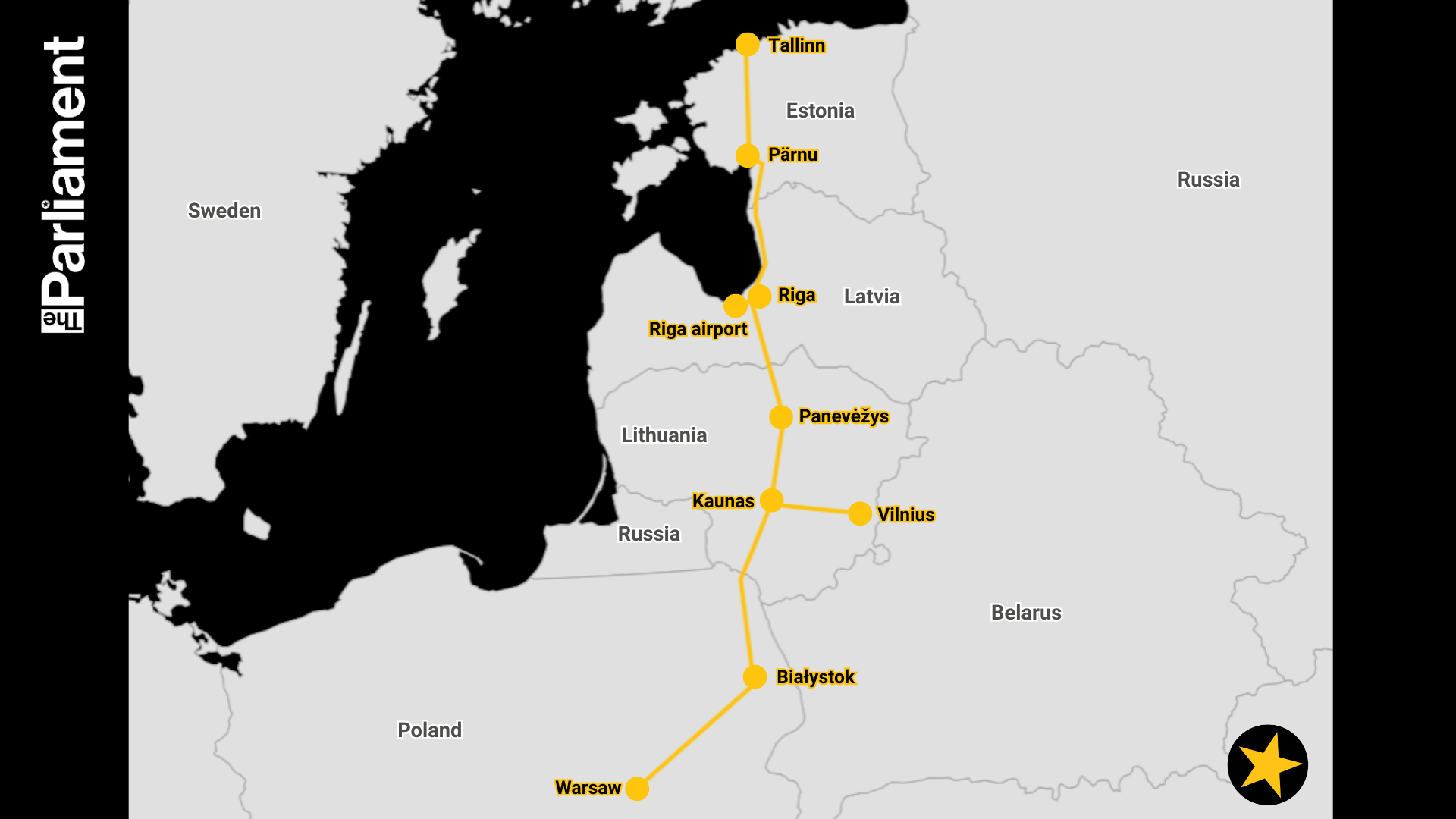 Rail Baltica is meant to connect the Baltics to the rest of Europe. (Latvian Transport Ministry)
Connecting the Baltics to Europe
Regardless of challenges facing the project, its completion is critical for the region’s security and economic future.
The Baltic states’ railways use a wider gauge than the European standard, a legacy of the Russian Empire and Soviet Union. Now the Baltics are ditching that inherited infrastructure for new links aligned with Western systems and standards. In February, they also joined the EU’s electric grid, fully disconnecting from the Russian and Belarusian networks.
Making this gauge switch as part of Rail Baltica “will physically tie the Baltic states to the rest of Europe, to Warsaw and Berlin,” said Mark Smith, an independent rail analyst and the founder of the popular train travel website The Man from Seat 61. The project will also bring the Baltics onto the European signaling system and enable faster connections between capitals.
In addition, transport of military equipment and evacuation of civilians occurs faster by train, according to Malwina Talik, an independent geopolitical analyst.
“Rail is the essential military critical infrastructure,” said Christian Leuprecht, a professor at the Royal Military College of Canada. “If you look at Ukraine, the most sustainable supply routes are rail routes.”
However, much of the Rail Baltica costs doesn’t count toward NATO’s target of spending 5% of GDP on defense by 2035, according to the Latvian Transport Ministry. Only limited portions of the project, such as freight terminals, qualify.
Opposition politicians and policymakers in Poland and Latvia have called to drop military mobility features to cut costs and prioritize completing passenger rail by 2030. Project officials, however, insisted that defense-related components were not up for cuts because military mobility is a key pillar of the project’s rationale and it wouldn’t be feasible to retrofit.
Perhaps the bigger question is what the project’s success — or failure — says about Europe’s ability to build complex, cross-national infrastructure projects to connect the continent. For Rail Baltica, Poland is on the hook for completing the final high-speed link from the Lithuanian border to the city of Ełk, while Finland sees the corridor as a promising route for its exports.
“It would be a testament that we're not splintered into a bunch of different states, but we can actually act in unison for our strategic environment, for our economy,” said Kivila. “Otherwise, we will lose out against the big players in the next 100 years."
Sign up to The Parliament's weekly newsletter
Every Friday our editorial team goes behind the headlines to offer insight and analysis on the key stories driving the EU agenda. Subscribe for free here.