That was the central message emerging from a breakfast discussion in the European Parliament hosted by Lithuanian MEP Aurelijus Veryga, in collaboration with Chiesi, the Italian pharmaceutical group.
The event brought together MEPs, clinicians and global health experts – including the World Health Organization’s Special Envoy for Chronic Respiratory Diseases, José Luis Castro – to discuss the impact of COPD, which represents the third leading cause of death worldwide.
The scale and complexity of the challenge was laid out by Paolo Saccò, Senior Director of Global Public Affairs at Chiesi. Saccò reminded participants that COPD affects some 36 million people in Europe alone. However this figure may not reveal the full picture – as diagnosis of COPD is often missed or delayed until the condition is at an advanced stage. Alarmingly, as many as 70 per cent of cases in Europe remain undiagnosed1. “We must ensure that COPD is no longer the world’s ‘forgotten’ non-communicable disease,” Saccò said.
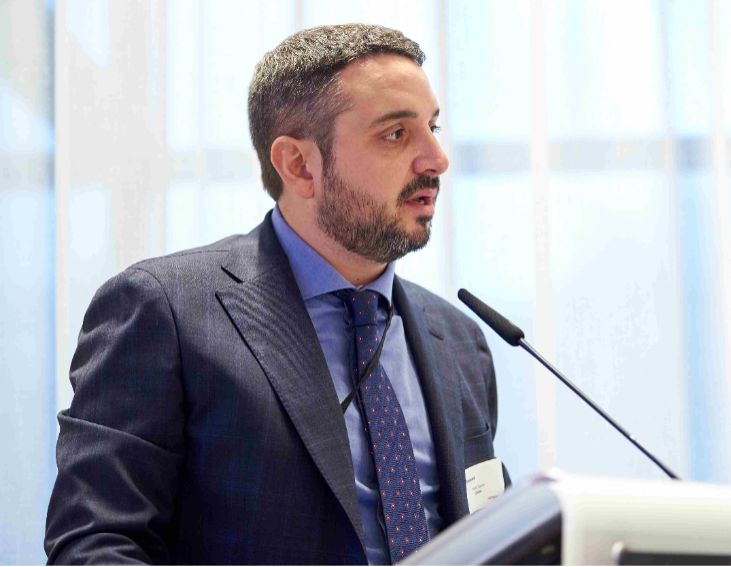 Paolo Saccò, Senior Director of Global Public Affairs at Chiesi
From the clinical perspective, Dr Didier Cataldo, Professor at the Laboratory of Tumours and the Development of Respiratory Diseases, described COPD as both complex and dangerously invisible. Patients can underestimate symptoms such as shortness of breath or may tend to associate them with smoking or ageing, while a lack of screening plans are a barrier to early detection in at-risk populations.
Cataldo argued that a relatively simple and low-cost diagnostic tool – spirometry –should be integrated into primary care systems much more systematically across Europe, particularly for those under the age of 40, where early intervention can significantly change disease trajectories.
Cataldo’s remarks echoed a recent report from the World Health Organization Europe, which warned that – despite being often preventable or manageable – chronic respiratory diseases such as COPD remain under-diagnosed, poorly managed and underestimated in their impact across the region. The report found that many patients face delayed diagnoses, barriers to care, and weak health-system support.
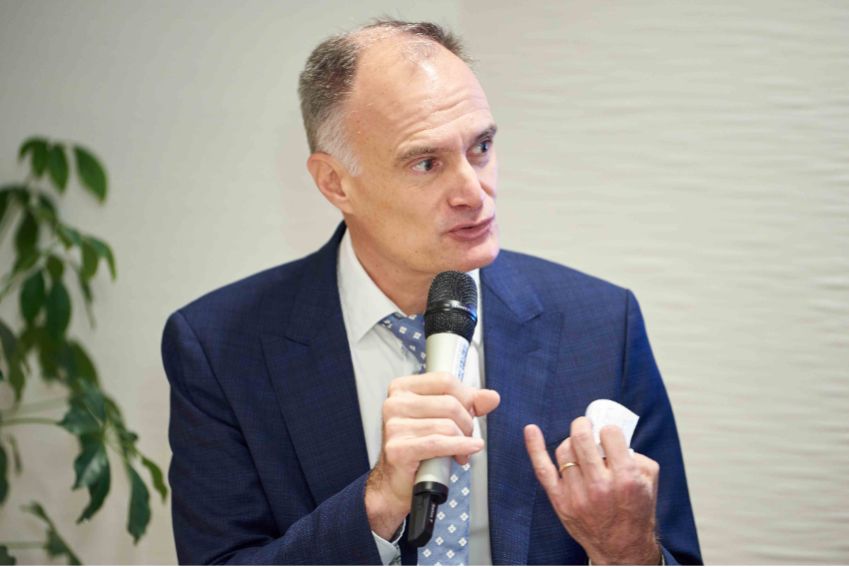 Dr. Didier Cataldo, Professor at the Laboratory of Tumours and the Development of Respiratory Diseases
Speaking at the event, the WHO’s Special Envoy for Chronic Respiratory Diseases, José Luis Castro, highlighted the impact that stigma and misinformation in particular have on under-diagnosis. COPD is still widely perceived as a “smoker’s disease,” he said, discouraging individuals from seeking diagnosis or treatment and undermining public investment in prevention. He echoed calls for earlier screening, stronger public awareness, and better integration of respiratory health into primary care.
A European action plan
Throughout the discussion speakers reiterated the need to give chronic respiratory diseases the same level of strategic attention as other major non-communicable conditions.
In 2024 EFPIA and the European Lung Health Group launched the #KeepBreathing campaign, calling on the European Commission to adopt a dedicated plan for chronic respiratory health built on prevention, early intervention, and equitable access to care.
Frazer Goodwin, Policy Coordinator at the European Federation of Allergy and Airways Diseases Patients’ Associations (EFA), echoed that demand, and noted that EU policy-makers have already demonstrated what is possible when political will exists. “Plans such as the Beating Cancer Plan and cardiovascular initiatives have improved screening, care pathways and prevention for millions,” he said, yet repiratory diseases lack a comparable, structured European strategy.
We must ensure that COPD is no longer the world’s ‘forgotten’ non-communicable disease
He also highlighted the importance of interoperability between EU health programmes, suggesting that the future Cardiovascular Health Plan could play a dual role by helping to support the earlier detection and diagnosis of related respiratory conditions, where co-morbidities and shared risk factors are common.
The host MEP Aurelijus Veryga – a member of SANT, the European Parliament’s committee on health – backed the call for an EU plan. “We have programmes on cardiovascular diseases and the Beating Cancer Plan. It should be the same for the chronic respiratory diseases that we discuss today,” he said.
Highlighting the disparities in access to treatment and diagnosis across the EU, Veryga said health must be seen as a priority in the upcoming MFF. “As a former Lithuanian health minister, I remember how hard it was to fight with my finance minister to get more resources for health issues, even during Covid,” he said.
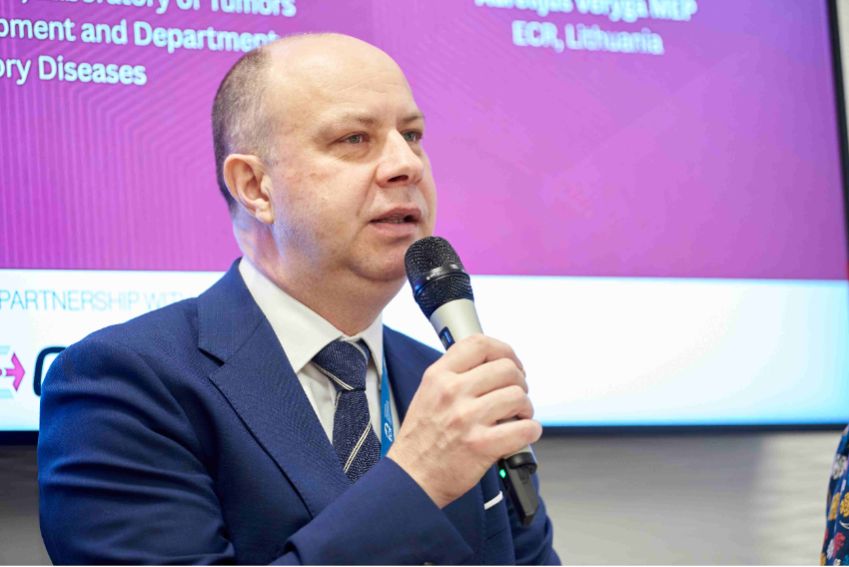 MEP Aurelijus Veryga (ECR, Lithuania)
He also underlined that Europe’s institutional approach to health is still evolving. The creation of the standalone SANT Committee during this mandate reflected an important step forward, but Veryga stressed that respiratory health requires attention well beyond one parliamentary body. It must be embedded as a cross-cutting priority in budgetary and strategic planning.
Prevention as an investment
From an economic and systems perspective, Thomas Allvin, Executive Director for Strategy and Healthcare Systems at EFPIA, described COPD as an under-recognised financial burden on European societies.
Due to its high prevalence and mortaility rate, COPD accounts for some 6% of total healthcare spending in the EU – equivalent to over €38bn per year. The cost to European economies in lost productivity is thought to be far higher.
 Thomas Allvin, Executive Director for Strategy and Healthcare Systems at EFPIA
Allvin argued that Europe must pivot towards a prevention-focused system based on early screening, environmental interventions, support for smoking cessation, AI-assisted diagnostics and more community-based healthcare. Such a shift, he said, is not only a public health necessity but an economic imperative.
Industry representatives including EUFOREA and GSK supported this view, pointing to increasing pressures on primary care systems and the promising role of emerging technologies.
These conditions are too often diagnosed late, resulting in higher costs, poorer outcomes, and unnecessary suffering
Early detection
Dr Zsuzsanna Miklós, of Budapest’s National Korányi Institute of Pulmonology, explained her role in the JARED initiative, which is developing coordinated, science-based approaches to combat chronic respiratory diseases such as COPD and asthma.
One of its most promising developments has been the use of mobile screening units, which allow healthcare services to reach rural or underserved areas. Early diagnosis, she stressed, is often the single most important factor in improving both survival rates and quality of life.
“These conditions are too often diagnosed late,” she said, “resulting in higher costs, poorer outcomes, and unnecessary suffering.”
By bringing screening into communities rather than waiting within overstretched hospital systems, JARED offers a model for equitable and scalable European action.
A European opportunity
As EU institutions shape the next multi-year budget, the case for prioritising respiratory health is becoming increasingly hard to ignore. With 36 million people in Europe affected by COPD – and many millions more thought to be undiagnosed – this not simply a health policy issue. It is about Europe’s ability to sustain a productive workforce, reduce preventable health costs, support innovation, and safeguard social resilience.
What emerged from the debate in the European Parliament was a growing consensus that only a dedicated EU action plan can close the gap between ambition and delivery.
List of references
- https://copd.efanet.org/about/#foreword
Sign up to The Parliament's weekly newsletter
Every Friday our editorial team goes behind the headlines to offer insight and analysis on the key stories driving the EU agenda. Subscribe for free here.